August 24, 2026
What learning two languages actually does for a toddler
Parents worry that a second language will confuse a young child or slow their speech down. Here is what paediatric and speech-language bodies actually say, what the research on early bilingualism has found, and what French and Mandarin immersion looks like day to day at our centre.
By Tracy, Owner and Principal
Most parents asking this question have heard both sides: that a second language in the toddler years gives a child a head start, and that it might confuse them or slow their talking down. The second claim is not supported by the paediatric and speech-language bodies that have looked at it.
Two languages do not confuse a young child
The Canadian Paediatric Society says plainly that exposure to two languages does not cause a language delay. Babies are able to sort out more than one language from the start.
A bilingual toddler may borrow a word from one language while speaking the other, inside the same sentence. That is a normal part of how two languages settle in. It is not a sign of confusion and it is not something to correct. If your child says a Mandarin word in the middle of an English sentence, the useful response is to repeat the sentence back naturally in the language you are speaking, and carry on with the conversation.
The American Academy of Pediatrics and the American Speech-Language-Hearing Association put it the same way in their own parent guidance: children reach the same developmental milestones no matter how many languages they hear. If you count the words a bilingual child knows across both languages together, the total comes out close to a child learning only one.
That last detail is the one that catches families out. A bilingual two year old may have fewer English words than a monolingual two year old and still know more words overall. Counting only one language gives you a misleading answer.
What the research does show
The Encyclopedia on Early Childhood Development reviewed the research on bilingual children and reported measurable differences from learning two languages early.
Bilingual children tend to do better on tasks involving mental flexibility and non-verbal problem solving. They also notice a communication gap sooner. A bilingual child works out earlier that a person who does not share their language cannot understand a request, and adjusts what they do about it.
There is a second, older line of research about timing, usually described as a critical period for language learning. The best-known recent study on it is Hartshorne, Tenenbaum and Pinker's 2018 paper in Cognition, which drew on responses from around two thirds of a million English speakers.
We are not going to give you an age from it. The full text sits behind a paywall, we have not read it, and an earlier version of this post carried two different ages in two places, which is exactly what happens when a number gets passed along rather than checked. What we can say is that the paper exists, that its bibliographic record has been verified, and that the general direction of the research is that earlier exposure helps. If a specific age matters to your decision, read the paper rather than a summary of it, including this one.
Keep the home language strong
Here is the part that often gets left out.
The Canadian Paediatric Society is specific that parents should keep speaking their own first language at home, even while their child is in a second-language program somewhere else. A parent speaking their strongest language gives a child the richest vocabulary and the clearest grammar to learn from.
A child with a strong first language also tends to pick up a second one more easily. Immersion at a centre is meant to sit alongside a family's home language.
In practice this means the most useful thing many parents can do is the thing they were already doing. Speak your own language at home, read in it, sing in it, argue about bedtime in it. You do not need to switch to English to help your child learn English, and switching often costs the family the language that was strongest.
The quiet period
One thing worth knowing before it happens, because it worries parents when it does.
Children starting in a new language often go through a stretch where they understand a great deal and say almost nothing in it. Weeks of this is common. Then it arrives in a rush.
Tell us if you are seeing it, and tell your doctor if you are worried. A quiet period and a language delay are different things, and telling them apart is work for a speech-language pathologist rather than for an educator or a website. What we can do is describe accurately what we hear and see in the room, which is usually useful information for whoever is assessing.
What this looks like at our centre
We run three ECE-certified language programs: French, Mandarin and English.
They run as separate programs rather than being combined into one group, so that educators can give focused, age-appropriate instruction in the chosen language. Children are not required to take all three. Parents tell us which program they would prefer and we try to accommodate it, subject to scheduling and availability.
Teacher Clara leads French. Teachers Anita and Beth lead Mandarin. Teachers Lana and Victoria lead English. Each of those educators speaks two or more languages. Assignments can change with scheduling.
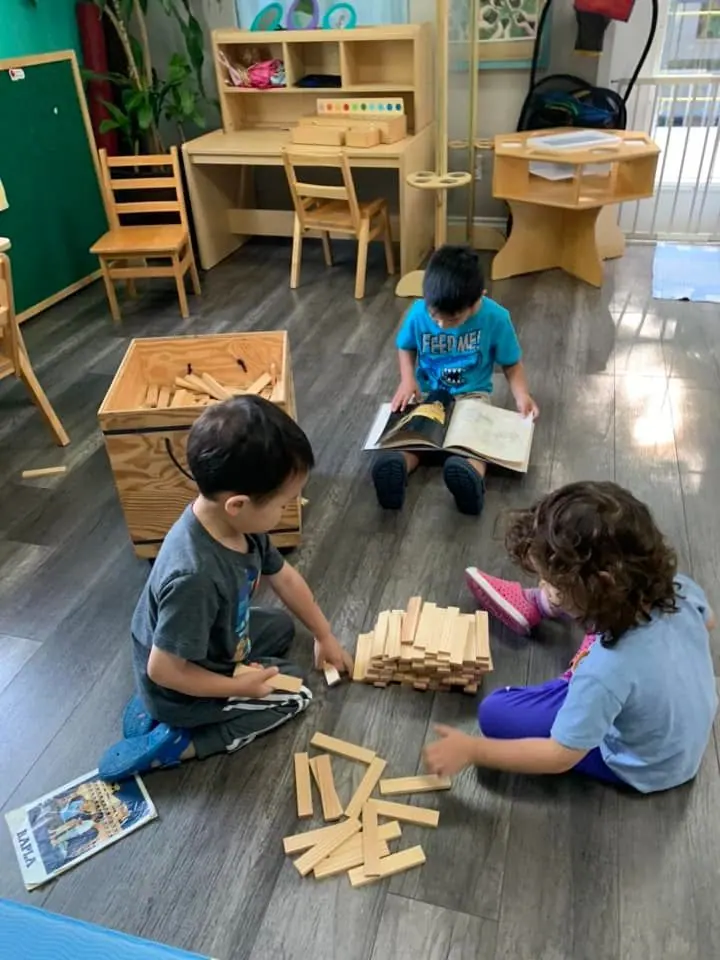
None of the three is taught as a separate lesson with a workbook. The language moves through the day the way a first language does: in songs, in picture cards, in stories read on the floor, in the back and forth of ordinary play. An educator narrates what is happening while it happens, in the target language, so a child connects the word to the thing rather than memorising a translation.
A family does not need to speak French or Mandarin at home for this to work. Most of ours do not.
Music does a lot of the carrying. Songs hold rhythm, stress and whole phrases together in a way that word lists do not, and a child will sing a sentence months before they would attempt to build one. The instruments in the afternoon block are part of the same thing rather than a separate activity.
Stories do the rest. The same book read repeatedly in one language gives a child the repetition they need without any of it feeling like practice, which is why you will see the same few titles in a room for weeks at a time.
Choosing which program
Families ask us which one to pick more often than they ask whether bilingualism works. There is no correct answer, but there are a few things worth weighing.
A language already spoken in your family. Choosing the language a grandparent speaks gives a child somewhere to use it outside the centre, which is worth more than an extra hour a week inside it. It also tends to hold, because the family keeps it going after the child leaves.
A language nobody in the family speaks. This works too, and plenty of our families do it. The thing to be realistic about is that the child's exposure will mostly be here, so progress tracks the time they spend in the program rather than starting from a base at home. Our guide covers choosing a language you do not speak in more depth.
What comes next at school. French has a public pathway in British Columbia through school district immersion programs. Mandarin does not have an equivalent public pathway in this district, so continuing it usually means a community program or family effort. That is not a reason against Mandarin. It is a reason to know in advance where the road goes.
What your child is drawn to. Less measurable and not nothing. A child who loves the songs in one program will get more out of it than a child who is enduring a language chosen for them.
You can also change your mind later. Tell us and we will look at what is possible, subject to scheduling and availability.
What we are careful not to promise
Two things, both of which you will see promised elsewhere.
We do not promise fluency. A child in a program here hears a language regularly inside a day they enjoy, which is a good foundation and is not the same as fluency. Anyone offering you fluency from a preschool program is selling something.
We do not promise an advantage in French immersion at school. French immersion in British Columbia is a school district program with its own entry point and its own registration process, and admission does not depend on what a child did before kindergarten. Early exposure gives a child familiarity with the sound and rhythm of the language. That is worth having, and it is a smaller claim than the one families sometimes arrive with.
The deeper research on all of this sits in our guide to raising a bilingual child, which carries the sources in full.
Frequently asked questions
Does learning two languages confuse a young child or delay their speech?
No. The Canadian Paediatric Society and the American Academy of Pediatrics both say exposure to two languages does not cause a language delay. A bilingual child may mix words from both languages in one sentence sometimes. That is normal and it does not mean the child is confused.
Will my child fall behind in English if they are also learning French or Mandarin?
Research reviewed by the Encyclopedia on Early Childhood Development finds bilingual children reach the same language milestones as children learning one language, when you count words across both languages together. A strong first language actually makes a second language easier to pick up, not harder.
Do I need to speak French or Mandarin at home for immersion to work?
No. The Canadian Paediatric Society recommends parents keep speaking their own first language at home, since that gives a child the richest vocabulary and grammar models. The second language at our centre is layered on top of that, through play, not in place of it.
Why do people say early is better for learning a language?
Because researchers have found a period early in life when language is learned most readily, which is why it is called a critical period. We do not publish a specific cutoff age here, because the studies disagree on where it falls and the one most often quoted sits behind a paywall we cannot ask you to take on trust.
My child mixes English and Mandarin in the same sentence. Should I correct it?
No. Mixing words from two languages inside one sentence is a normal part of how two languages settle in, and paediatric guidance describes it as expected rather than as a problem. Repeat the sentence back naturally in whichever language you are speaking, and carry on.
My child has been silent in the new language for weeks. Is that normal?
Many children go through a quiet period when they are absorbing a new language before producing it. Talk to us about what you are seeing, and raise it with your doctor or a speech-language pathologist if you are worried, because a quiet period and a language delay are different things and we are not qualified to tell them apart.
Does my child have to take all three languages at your centre?
No. French, Mandarin and English run as separate programs rather than being combined into one group, and children are not required to take all three. You tell us which one you would prefer and we try to accommodate it, subject to scheduling and availability.
Will a second language at daycare help with French immersion at school later?
It is a reasonable hope and we will not promise it. French immersion in British Columbia is a school district program with its own entry point and its own registration, and admission does not depend on preschool experience. What early exposure gives a child is familiarity with the sound of the language, which is worth having on its own terms.
Before you visit
If you want to see what a Mandarin or French morning actually looks like, come by. We would rather show you a room in motion than describe one.
We are at 1103 Confederation Drive in the Citadel neighbourhood of Port Coquitlam. The program details are here, our team lists the educators who lead each language, and you can arrange a visit whenever suits you.
Copies a ready-written post, then opens LinkedIn.