6-part guide
Early learning and play, what young children are actually doing all day
A parent's guide to how early learning works in British Columbia. Covers the four living inquiries in the provincial Early Learning Framework, the five program standards every licensed centre must meet under Schedule G, why play builds executive function, and what school readiness does and does not mean.
By Tracy, Owner and Principal
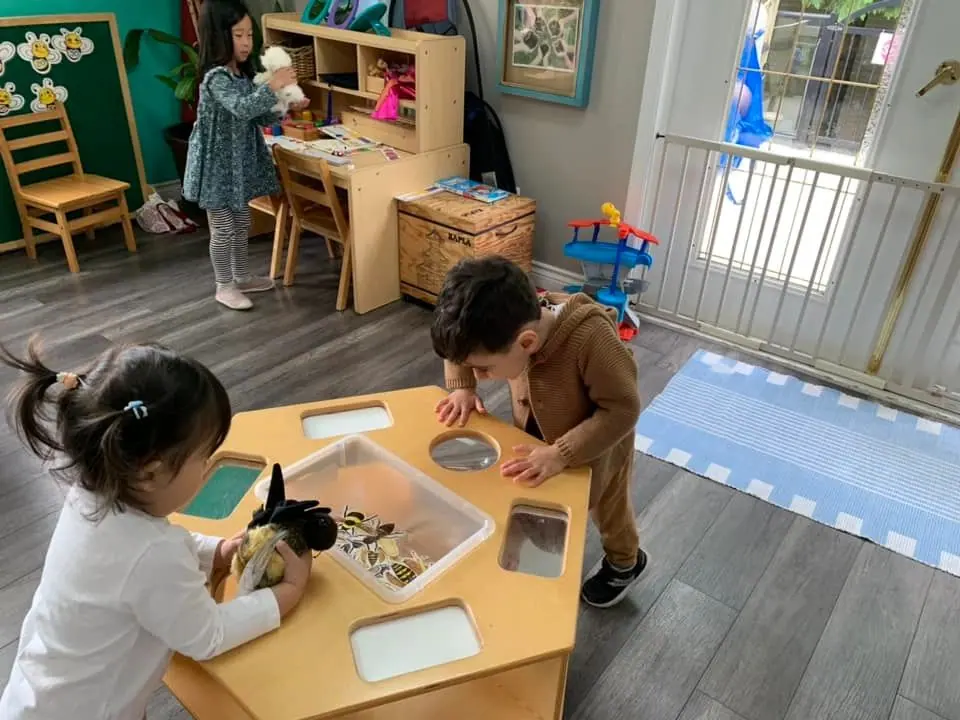
A parent stands at the door at five o'clock and asks what their child did today. The answer is often some version of "they played". It is an honest answer and it sounds like nothing happened.
This guide is about what is actually happening. Not a defence of play as a nice thing for small children, but an account of the structure underneath it: a provincial framework that tells educators how to think, a regulation that sets out five kinds of development every licensed centre must support, and a body of paediatric evidence on what play does to a developing brain.
Three separate things get confused in this conversation, so it is worth separating them at the start.
The Early Learning Framework is the Province's guide to early learning. It is philosophy and pedagogy, published by the Ministry of Education, revised in 2019. It has no legal force. No inspector checks a centre against it.
Schedule G of the Child Care Licensing Regulation is law. It sets out five program standards a licensed centre must meet, and a licensing officer can inspect against them.
The evidence base, from paediatric and developmental research, is the reason both documents say what they say.
A centre can meet Schedule G without ever opening the framework. A centre can quote the framework beautifully and still run a thin programme. Knowing which document you are being shown is the first useful thing a parent can learn.
The law: five kinds of development, and none of them optional
Section 44 of the Child Care Licensing Regulation requires a licensee to provide a comprehensive and coordinated program of indoor and outdoor activities, designed for the development and care of children, appropriate to the age and development of each group, and complying with the program standards in Schedule G.
Schedule G then names five areas. They are worth reading closely, because each one contains requirements that most parents would not guess.
Physical development. Indoor and outdoor activities encouraging the development of large and small muscle skills appropriate to each child's level of development, activities promoting self-help skills, and activities encouraging good health and safety habits. Note that self-help sits here. A child learning to manage their own coat is meeting a legal program standard.
Intellectual development. This is the longest of the five. It requires a flexible daily program that responds to the needs and interests of the children; an environment facilitating curiosity, reasoning and problem-solving; age-appropriate activities encouraging concept-building skills such as classifying, ordering, determining direction and perceiving spatial relationships; activities and materials encouraging creative endeavours such as art, music, movement, imaginative play, story-telling and construction; and activities fostering a greater understanding of the environment.
Read that list again with a block area in mind. Classifying, ordering, determining direction, spatial relationships, construction. The regulation describes a child stacking blocks.
Language development. Modelling of good language and listening skills, opportunities for children to develop receptive and expressive language skills, and activities that encourage communication. Receptive and expressive are named separately on purpose. Understanding language and producing it are different capacities that develop on different timelines.
Emotional development. Helping children develop a positive self-concept and an accurate perception of self, helping children express positive and negative feelings in appropriate ways, and providing a comfortable atmosphere in which children can feel proud of their cultural heritage.
The word "accurate" is doing real work there. The standard is not maximum self-esteem. And negative feelings are named in the regulation, which means a programme where children are only ever redirected into cheerfulness is not meeting the standard. A child learning to say they are angry is doing scheduled work.
Social development. An environment for children to work independently and to share and work cooperatively in small groups; an environment fostering positive behaviour; helping children appreciate differences and respect the personal feelings and property of others; opportunities for social interactions that help develop skills for relationships; and experiences that give a child a feeling of belonging to family, community and the world.
That is the floor. Every licensed centre in British Columbia, whatever its philosophy, is meeting these five or is out of compliance.
The framework: how educators are asked to think
The Early Learning Framework does something different. It does not tell an educator what to provide. It tells them how to look.
The 2019 revised edition covers children from birth to age eight, widened from the birth to five range of the original. It sets out nine principles. Among them: children are strong, capable in their uniqueness, and full of potential; families have the most important role in contributing to children's well-being and learning; educators are researchers and collaborators; play is integral to well-being and learning; relationships are the context for well-being and learning; and learning is holistic.
The framework then describes four living inquiries:
- Well-being and belonging
- Engagement with others, materials, and the world
- Communication and literacies
- Identities, social responsibility, and diversity
The vocabulary changed in 2019 and the change matters. What the 2008 framework called "areas of learning" became "living inquiries". What it called "learning goals" became "pathways". The framework explains the choice: "living" suggests processes that are ongoing and always evolving, and "inquire" means to pay attention in multiple ways, to study, explore, experiment and ask questions. "Pathways" was chosen to evoke movement that is not linear.
The wording carries a meaning. An "area of learning" with a "goal" implies a destination and a child who has or has not arrived. A living inquiry with pathways implies a child in motion. The framework states the belief plainly: children learn by doing when they are engaged in projects and inquiries that extend their interests.
Two practical notes for parents. First, if you search for the framework's areas of learning you will find pages listing the 2008 names, including "Exploration and Creativity" and "Social Responsibility and Diversity". Those are from the superseded edition. The four above are from the 2019 document.
Second, the framework is a provincial guide, not a licensing requirement, and a centre is not failing anything by not citing it. Ask what a centre actually does. The framework is most useful to you as a vocabulary for that question.
What play does, according to the paediatric evidence
The American Academy of Pediatrics published a clinical report in September 2018 titled "The Power of Play: A Pediatric Role in Enhancing Development in Young Children", reaffirmed in January 2025. Its argument is that developmentally appropriate play with parents and peers is a singular opportunity to promote the social-emotional, cognitive, language and self-regulation skills that build executive function and a prosocial brain.
Executive function is the useful concept here. It covers planning, decision making, holding a goal in mind and ignoring distractions. It is the process of learning rather than the content of it. A four year old negotiating who is the shopkeeper is running all of it at once: holding a shared fiction, tracking someone else's intention, suppressing the impulse to grab, and repairing the game when it breaks down. There is no worksheet equivalent.
This is why the answer "they played" is a poor summary of a good day, and why the better question at pick-up is not what your child made but what they were working on.
Bodies: what a day should contain
The Canadian 24-Hour Movement Guidelines for the Early Years, from the Canadian Society for Exercise Physiology, set out what a healthy 24 hours looks like for children aged nought to four. They cover movement, sitting and sleep together, because the three trade off against each other.
- Infants under one. Physically active several times a day in a variety of ways, particularly through interactive floor-based play. At least 30 minutes of tummy time spread through the day for those not yet mobile. Not restrained more than one hour at a time. Sleep of 14 to 17 hours for nought to three months, 12 to 16 hours for four to eleven months.
- Toddlers aged one and two. At least 180 minutes of physical activity at any intensity, spread through the day. Not restrained more than one hour at a time. Sleep of 11 to 14 hours including naps, with consistent bedtimes.
- Preschoolers aged three and four. At least 180 minutes of physical activity, of which at least 60 minutes is energetic play. Sleep of 10 to 13 hours, which may include a nap.
Each recommendation carries the phrase "more is better" for activity. The restraint limit is the one parents rarely hear: an hour at a stretch in a stroller, high chair or car seat is the ceiling, and a long errand run can quietly exceed it.
At La Vie Est Belle, outdoor time generally runs one to two hours a day, depending on weather, air quality and the schedule. On rainy or snowy days the children stay in and educators run indoor movement and gross-motor activities instead. Section 44(3) of the regulation requires daily outdoor play periods "unless weather conditions would make it unreasonable to do so", and a Lower Mainland winter supplies plenty of those days.
Screens
The Canadian Paediatric Society's position statement, posted 24 November 2022, is specific by age. For children younger than two, screen time is not recommended, apart from video-chatting with caring adults. For children aged two to five, routine or sedentary screen time should be limited to about one hour or less per day.
Three further points from the same statement carry more weight than the number itself. Avoid screens for at least an hour before bedtime, because of stimulating and melatonin-suppressing effects. Keep daily screen-free times, especially family meals and book-sharing. And where screens are used, choose content together and watch it with the child, because an engaged adult changes what the time is worth.
The hour is a household budget, not a per-setting allowance. A centre running a screen-light day gives you room at home rather than adding to it.
School readiness, and what it actually measures
Parents of four year olds ask whether their child will be ready. The honest answer is that British Columbia has no kindergarten entry test and no requirement that a child arrive knowing letters or numbers.
What the province does have is the Early Development Instrument, administered here by the Human Early Learning Partnership at the University of British Columbia. It is a questionnaire completed by kindergarten teachers each February about the children already in their classrooms, and it measures five domains: physical health and well-being; social competence; emotional maturity; language and cognitive development; and communication skills and general knowledge.
Two features of that list are worth sitting with. It is filled in by the teacher, in February, months after the child started, so it is a description of how a cohort arrived and settled rather than an exam anybody passes. And three of its five domains are about health, social competence and emotional maturity. A child who can separate from a parent, join a group, manage a disappointment and ask for help is doing well against most of what the instrument looks at.
The EDI reports at the level of neighbourhoods and populations, which is what it was built for. It is not a report card on your child, and no individual result is returned to a family.
Reading a programme when you tour
Four questions that get past the display wall.
"What has this group been interested in lately, and what did you change because of it?" Schedule G requires a flexible daily program responding to children's needs and interests. A strong answer names a child or a group and a change. A weak answer describes the timetable.
"What do children do here when they are upset?" The emotional development standard requires helping children express positive and negative feelings appropriately. Listen for a described process, not for the assertion that the children are happy.
"How much of the day is child-chosen?" There is no correct percentage. What you want is that the person answering knows the answer.
"What happens on a rainy day?" Every Lower Mainland centre has a plan for this or has a problem. Here the answer is indoor movement and gross-motor activities, and the children do not go out in rain or snow.
At La Vie Est Belle, children are typically organised into three groups across three classrooms by age, developmental needs and daily attendance, each with a designated educator and additional educators supporting through the centre. Generally four to five educators are present each day, always meeting the staff-to-child ratios licensing requires. Tours run about 30 minutes by appointment, and families are encouraged to bring their child.
What the rest of this guide covers
Each page below is written to be read on its own.
How early learning is organised. The BC Early Learning Framework covers the provincial guide in detail: its nine principles, the four living inquiries, and why the vocabulary changed in 2019. What a licensed daycare programme must cover reads Schedule G clause by clause, which is the legal floor every centre in the province stands on.
What children are doing. What play actually builds covers executive function and the different kinds of play. Movement, sleep and screens has the Canadian figures by age. Art, music and messy play explains what the brown painting was for.
Looking ahead. School readiness and milestones covers what British Columbia actually measures, and what to do if you are worried about your child's development.
Three other guides on this site sit alongside this one. Licensed child care in British Columbia covers the rules a centre must follow and how to check that it is following them. Starting daycare covers the period between accepting a space and a settled child. Raising a bilingual child covers young children learning more than one language.
The full guide
Every part of this guide
How early learning is organised
- Part 1The Early Learning FrameworkThe Province's guide to early learning, what its four living inquiries actually mean, why the vocabulary changed in 2019, and why the version you find through a web search is probably the old one.Read part 1
- Part 2What the programme must coverSchedule G of the Child Care Licensing Regulation sets out five kinds of development every licensed centre must support. What each one actually requires, and what it looks like in a room full of three year olds.Read part 2
What children are doing
- Part 3What play actually buildsExecutive function, self-regulation and the reason a four year old arguing about who is the shopkeeper is doing harder work than a four year old filling in a worksheet.Read part 3
- Part 4Movement, sleep and screensThe Canadian 24-Hour Movement Guidelines and the paediatric screen time advice, by age, with the restraint limit most parents have never heard and the reason the hour before bed matters more than the hour itself.Read part 4
- Part 5Art, music and messy playWhy the process matters more than the painting that comes home, what instruments do for a two year old, and the developmental case for letting a child get filthy on purpose.Read part 5
Questions parents ask