Part 5 of 6
Art, music and messy play, and what they are for
What art, music and messy play develop in young children, why a licensed BC centre is required to provide them under Schedule G, how to talk to a child about their own work, and what sensory and water play teach before a child has words for volume or sequence.
By Tracy, Owner and Principal
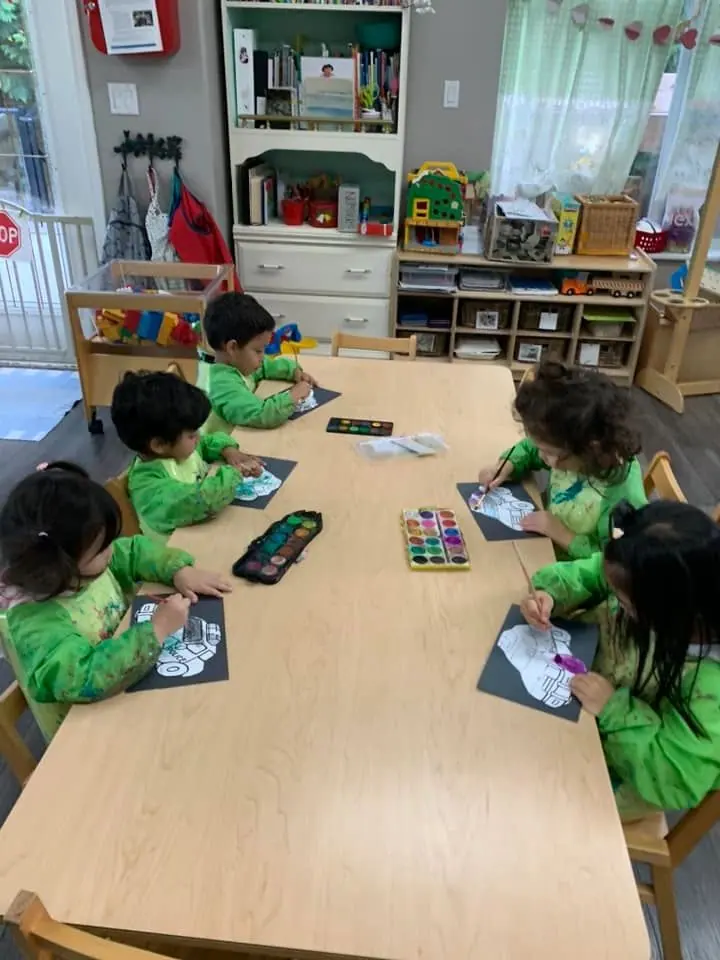
A painting comes home. It is brown, because every colour was mixed together, and the paper has a hole in it where the brush went through. The instinct is to admire it warmly and quietly recycle it later.
That painting is a record of an experiment. This page is about what the experiment was.
Process, not product
The single most useful idea in early childhood art is that for a young child the interesting part is the doing, and the object left behind is a by-product.
An adult paints in order to have a painting. A three year old paints in order to find out what happens: what red does when it meets yellow, what the brush does when pressed hard, how much water the paper takes before it gives way. The brown page is the answer to several questions asked in sequence, and the hole is the answer to the last one.
Schedule G of the Child Care Licensing Regulation requires activities and materials that encourage creative endeavours such as art, music, movement, imaginative play, story-telling and construction. It sets no standard for the result, because the result is not the point.
This has a direct consequence for what you say at the kitchen table.
"That's beautiful" is warm and it closes the conversation. It also teaches, over hundreds of repetitions, that the purpose of making something is to obtain adult approval, which is the opposite of the disposition worth building.
"What is it?" assumes the child set out to represent something, which they often did not. A child who was investigating pressure and colour now has to invent a subject to satisfy the question.
Describing what you see works better. "You used a lot of blue over here, and this part took some real pressing." That is observably true, it requires no judgement, and it hands the conversation back to the child. Then ask about the doing rather than the thing: what was the messiest part, which bit took longest, did anything go wrong.
What messy play is actually teaching
Sand, water, dough, paint, mud, and the various sensory materials that make adults reach for a cloth.
Section 2 of Schedule G requires age-appropriate activities encouraging concept-building skills such as classifying, ordering, determining direction and perceiving spatial relationships. Read that with a water table in mind.
A child fills a tall narrow container, pours it into a wide flat one, and notices the level is different. That is volume, and the fact that a quantity can look different while staying the same. Nobody can explain this to a three year old in words that will land. They have to do it with their hands, dozens of times, until it becomes obvious.
Sand does something similar for quantity and flow. Dough does resistance and transformation, and it does hand strength, which is the same musculature that will later hold a pencil. Sorting anything into groups is classification, the foundation under every category a person will ever use.
None of this requires the adult to name it. It requires the material to be available and the time to be uninterrupted.
At La Vie Est Belle, water play is seasonal and messy play is hands-on, both actively supervised, with age-appropriate materials and clear safety boundaries. Activities stop if conditions become unsafe. Sharing and turn-taking get practised alongside the sensory work, because a water table holds a limited number of children and the negotiation is part of the offer.
The practical requirement on families is clothes that can be ruined. The centre asks for clothing that can get messy and at least two complete changes kept at the centre, and that is not an inconvenience attached to the programme. It is what makes the programme possible. A child dressed in something precious will be told to be careful, and careful is the wrong instruction for this work.
Music, and what a drum is for
At the centre the instruments are drums, tambourines, rhythm sticks, shakers, bells and xylophones, with educators supervising safe use while children explore rhythm, sound, movement and expression.
Percussion dominates that list for a reason. A satisfying sound arrives immediately, with no technique standing between the child and the result. Hit the drum, get a noise. Hit it harder, get a louder noise. That is cause and effect under the child's own control, which is one of the most compelling discoveries available at two years old.
Group music adds something a solitary instrument cannot. Playing together requires listening while doing, matching a tempo somebody else set, and stopping when the group stops. That is attention and turn-taking, practised in a form so enjoyable that a child will repeat it far past the point where they would tolerate being asked to wait.
Singing does a different job again, and it is closer to literacy than to music. Rhyme and rhythm pull a child's attention to the sound structure of words: that "cat" and "hat" share an ending, that a line has a number of beats. Noticing the sounds inside words is the same attention reading will later require. Section 3 of Schedule G requires activities that encourage communication and opportunities to develop receptive and expressive language, and songs sit squarely inside it.
A caution worth stating plainly: none of this means music makes children cleverer in some general way. The claims worth making are the specific ones above.
The framework's view
The BC Early Learning Framework puts art and music somewhere that surprises people. They sit under the living inquiry on communication and literacies, which describes children using multiple modes of expressive languages to communicate ideas, participate in relationships and make meaning in their homes and communities. Its pathways include multiple modes of communication, and sound and word play.
The claim embedded there is that a painting and a song are languages. A three year old whose spoken vocabulary cannot yet carry what they mean has other channels available, and a programme that offers only words has narrowed what that child can say.
The framework also holds that environments are integral to well-being and learning, which is why displaying children's work is a decision rather than decoration. A child who sees their own painting on the wall learns that what they made mattered to the adults in the room.
At La Vie Est Belle, holiday-themed artwork usually goes home the same day. Other selected pieces may be displayed at the centre first, then returned to families or collected in a personalized art book given to the family. Timing varies by activity, so a quiet week in the bag is not a week without art.
Templates, and the display wall problem
Colouring sheets, pre-cut shapes and craft kits where every child produces the same reindeer.
These are not harmful. They practise fine motor control, cutting, and following a sequence of instructions, all of which are real skills.
What they do not do is the open-ended work described above, where the child decides what to make and then meets the problems that follow from their own decision. A template has already made every decision. The child executes.
There is also an honest reason templates are popular that has nothing to do with children: twenty identical reindeer make an excellent display wall, and parents read a good display wall as evidence of a good programme. The incentive runs the wrong way.
So the question on a tour is balance, not prohibition. A room with both is fine. A room where every visible piece of work is recognisably the same object twenty times over is telling you where its effort goes.
What to look for, and what to ask
Materials within reach. Whether children can get paper, tape and crayons themselves, or have to request them. Access shapes how often a child starts something.
Evidence of unfinished work. A construction left standing to be continued tomorrow indicates a programme that protects a child's project. The framework names "time for engagement" as a pathway in its own right.
Variety in what is displayed. Different sizes, different subjects, obvious differences in skill. Uniformity is the tell.
Ask what happens when a child does not want to join. The answer reveals whether art is offered or administered.
And at home, the most useful thing to provide is materials that are available without asking, somewhere the mess does not matter, and enough uninterrupted time for a child to get past the first idea.
The wider case for open-ended play is in what play actually builds, and the vocabulary used above comes from the BC Early Learning Framework. What to pack so a child can join in properly is covered in what to pack.
Questions parents ask
Frequently asked questions
Early learning and play