Part 3 of 6
What play actually builds, and why it looks like nothing
What the paediatric evidence says about play in early childhood. Covers the American Academy of Pediatrics clinical report on play, executive function and self-regulation, the different kinds of play and what each one develops, and why adult-directed activities are not automatically more educational.
By Tracy, Owner and Principal
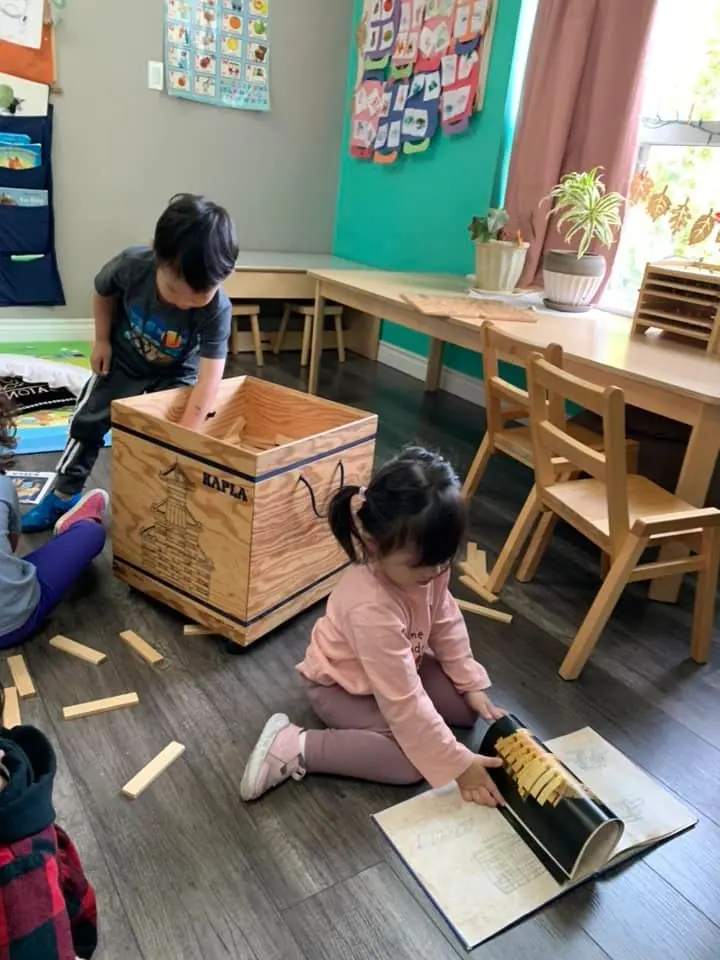
There is a particular kind of guilt that arrives when a parent picks up a child from daycare, asks what they did, and hears that they played in the sandpit. Somewhere there is presumably a child of the same age learning letters, and the sandpit feels like a wasted afternoon.
This page is about why that instinct is backwards, and what the evidence actually says is happening in the sandpit.
The clinical position
In September 2018 the American Academy of Pediatrics published a clinical report titled "The Power of Play: A Pediatric Role in Enhancing Development in Young Children", by Michael Yogman and colleagues, in the journal Pediatrics. It was reaffirmed in January 2025, meaning the Academy reviewed it and let it stand.
Its central claim is that developmentally appropriate play with parents and peers is a singular opportunity to promote the social-emotional, cognitive, language and self-regulation skills that build executive function and a prosocial brain.
The phrase doing the most work there is the process of learning rather than the content. A child who knows twenty letters has content. A child who can hold a goal in mind, tolerate a setback and try a different approach has process. The second one is what the report argues play builds, and it is the capacity the first one eventually needs in order to be useful.
The report is written for paediatricians, and one of its practical recommendations is that doctors can write prescriptions for play at well visits. That is a fair measure of how seriously the position is held.
Executive function, in a body four years old
Executive function is a cluster: planning, decision making, holding information in mind while using it, and inhibiting an impulse that would get in the way. The Academy describes these capacities as foundational for lifelong flourishing, supporting planning, decision making and self-regulation.
Watch what a shared pretend game demands of a four year old.
She has agreed to be the shopkeeper. That means holding a rule in mind across several minutes while other things happen. Her friend arrives as a customer, which requires her to track someone else's intention and respond to it in character. She wants the blue basket, but the shopkeeper does not get the basket, so she has to suppress her own preference in favour of the role. Then a third child arrives and declares the shop is on fire, and the two of them have to negotiate a repair to the fiction or lose the game.
Memory, perspective-taking, impulse control, and social negotiation, running at once, for as long as the game holds. No adult set that task, and no worksheet contains it.
This is the answer to the sandpit guilt. The visible output of the letter worksheet is a page. The invisible output of the shop game is the machinery that will one day let a child sit down and work through a page.
Different kinds of play do different jobs
Play is not one activity, and a good programme runs several.
Physical play. Running, climbing, carrying heavy things, and rough and tumble. Builds the large muscle skills section 1 of Schedule G requires a programme to encourage. Rough and tumble also teaches something subtler: how to read whether the other child is still enjoying this. The test is consent and reciprocity, so the useful adult question is whether everybody is still choosing it.
Object play. Filling, pouring, stacking, sorting, dismantling. This is where a child meets volume, balance, sequence and category before they have words for any of them. Schedule G names the ground directly: classifying, ordering, determining direction and perceiving spatial relationships.
Pretend play. Described above. The heaviest cognitive load of the group.
Constructive play. Building something with an outcome in mind, which requires holding a plan across time and revising it when the tower falls. Schedule G names construction among the creative endeavours a programme must encourage.
Social play with rules. Simple games with turns. Practice at waiting, which is self-regulation in its most concentrated form.
A room that offers only one of these is thin, however busy it looks.
Why repetition is not stalling
Adults find children's repetition tedious, and read it as a lack of progress. It is the opposite.
A toddler who drops a spoon from the high chair twenty times is not being difficult. They are testing whether the result is stable, which is what any experiment does. A three year old who wants the same book every night is checking that the story still ends the way it did.
The BC Early Learning Framework describes learning processes as ongoing and always evolving rather than linear, which is why its 2019 edition replaced "learning goals" with "pathways". The First Peoples Principles of Learning embedded in the framework put it more plainly still: learning involves patience and time.
The adult's job
Two failure modes sit either side of the useful position.
Absence. An adult who treats play as childminding, present but not attending, misses the moments where a small intervention would open something up.
Takeover. An adult who joins a game and starts directing it removes the negotiation, which was the part doing the work. The children become performers of an adult's plan.
Between them is something harder: an adult who watches closely, adds a material or a question at the right moment, and otherwise stays out of it. The Early Learning Framework describes educators as researchers and collaborators, and that is what the phrase means in practice. The Academy's report is explicit that play with parents and peers matters, so joining in is part of the picture rather than an intrusion.
The most useful thing an adult adds is usually not an idea. It is time. The framework names "time for engagement" as a pathway in its own right, which makes protecting an absorbed child from interruption an actual professional duty.
Unstructured does not mean unsupervised
"Free play" invites a misunderstanding worth clearing up. It does not mean children do whatever they want in an empty room.
The adult sets the frame: which materials are out, how the space is arranged, how long there is, and the non-negotiable rules about safety and how people treat each other. Section 5 of Schedule G puts the duty on the setting, not on the child, requiring an environment that fosters positive behaviour. A single popular toy in a group of twelve creates a conflict that is a design problem first.
Inside that frame the child chooses. The choosing is the point, because a choice a child did not make cannot teach them to make choices.
At La Vie Est Belle the messy and water play run seasonally, actively supervised, with age-appropriate materials and clear safety boundaries, and activities stop if conditions become unsafe. That is the shape: a real frame around real freedom.
The play a child cannot do alone
Some of what play builds only appears when there is more than one child, which is an argument for group care that has nothing to do with convenience.
A child playing alone can practise almost everything on the list above except one thing: the discovery that another person's mind contains something different from what is in theirs. That arrives through friction. Two children want the same digger. One believes the game is about rescue and the other believes it is about fire. The tower one child spent ten minutes on gets knocked down by someone who did not notice it was a tower.
Each of those is a small crisis, and each is a rehearsal. The child has to work out what the other one wants, weigh it against what they want, and find something that lets the game continue. Section 5 of Schedule G names this as a requirement: opportunities for social interactions that help children develop appropriate skills for social relationships, and helping children appreciate differences and respect the personal feelings and property of others.
The adult instinct is to resolve these quickly, and sometimes that is right. A child who is frightened or hurt needs an adult now. But an adult who settles every dispute within four seconds has taken the rehearsal away. The harder skill an educator practises is knowing which conflicts to let run a little longer, standing close enough that the children know help exists.
This is also why the size and stability of a group matters. Children who see the same faces every week build the kind of relationship where a disagreement is survivable, because there is a history on both sides of it. At La Vie Est Belle children are typically organised into three groups across three classrooms by age, developmental needs and daily attendance, each with a designated educator and additional educators supporting through the centre.
When play is the same thing every day
A reasonable worry: my child only ever plays with the dinosaurs. Is that a problem?
Usually not, and the framework's vocabulary helps here. A deep interest that a child returns to for weeks is what the 2019 Early Learning Framework describes when it says children learn by doing when they are engaged in projects and inquiries that extend their interests. Depth is not narrowness. A child who has been on dinosaurs for a month has usually been counting them, sorting them, building homes for them, arguing about which is strongest and inventing elaborate rules about what they eat. The dinosaurs are the doorway rather than the room.
What a good centre does with that is extend it: adding measuring tapes when the interest turns to size, or books when it turns to names. That is the flexible daily program responding to children's interests which section 2(a) of Schedule G requires, and it is the most visible sign that a programme is watching the actual children in front of it.
The version worth asking about is different: a child who seems unable to leave one activity, becomes distressed when the routine changes, or does not appear to notice the other children at all. That is a conversation for the centre and your health care provider rather than something to read about, and raising it early costs nothing.
What to ask, and what to listen for
At pick-up, "what did you make?" invites a child to produce evidence. "What were you working on?" or "who did you play with?" gets closer to the day.
On a tour, ask what a group of children has been interested in lately and what the centre changed because of it. Schedule G requires a flexible daily program responding to children's needs and interests, so a centre should be able to name a child, an interest and a decision. An answer that describes the timetable is describing the timetable.
And if a centre tells you the children mostly play, that is not an admission. It is a description of the most cognitively demanding thing a four year old does.
The legal requirements behind all of this are set out in what a licensed daycare programme must cover. For the specific case of paint, sand and instruments, see art, music and messy play.
Questions parents ask
Frequently asked questions
Early learning and play