October 8, 2026
Screen time and young children, and why the daycare day has none
What the Canadian Paediatric Society actually recommends for children under two and ages two to five, why the number is less important than what screens displace, and how a screen-free daycare day changes the arithmetic at home.
By Tracy, Owner and Principal
Nearly every conversation about screens and small children collapses into a number, and the number generates a quantity of guilt out of all proportion to what it can actually tell you.
The numbers are real and worth knowing. They are also the least useful part of the topic, and starting there sends most families down an unhelpful path.
What the guidance says
The Canadian Paediatric Society's advice for young children is specific.
For children under two, screen use is not recommended, because, as the guidance puts it, they do not learn from it. The exception named is video chatting with caring adults, such as extended family.
For children aged two to five, the recommendation is to limit routine or sedentary screen use to about an hour or less per day.
Those are the figures. Now the more useful question.
A screen does not add time, it takes it
This is the reframing that makes the whole subject tractable.
A day has a fixed number of hours in it. A screen never adds an activity to that day, it always displaces one. So the question that actually changes a decision is not how much is too much. It is: what is this twenty minutes replacing, right now, in this house?
Twenty minutes of a programme while a parent gets dinner cooked, replacing a fourth lap of the living room and some low-grade whining, is doing a genuine job. It is buying a parent the ability to feed everyone, which has obvious value.
Twenty minutes replacing the only stretch of back-and-forth conversation that would have happened in that hour is a different trade entirely.
Identical number. Identical content. Completely different transaction, and only the parent standing in that kitchen knows which one it is.
This is also why the guilt is usually misallocated. Parents who feel worst about screens are often the ones whose children have plenty of everything else. Meanwhile a lower number can sit on top of a day with very little talk in it.
Why under two is treated differently
The reason is not that screens are toxic to a one-year-old. It is that very young children learn language from a particular thing that a recording cannot do.
Babies and toddlers acquire language through back-and-forth interaction with a person who responds to them. The child makes a sound, an adult reacts, the child reacts to the reaction. That loop, running thousands of times, is the mechanism.
A recording cannot participate in it. It carries on regardless of what the child does. This is why a child under two can watch a programme full of words and take almost nothing from it, while the same words from a person in the room land.
It also explains the video chat exception precisely. A grandparent on a video call is a real person, responding in real time, waiting, laughing at the right moment. The loop still works, so the Canadian Paediatric Society treats it differently.
The arithmetic that helps families in full-time care
Here is something worth doing on the back of an envelope if you use full-time childcare.
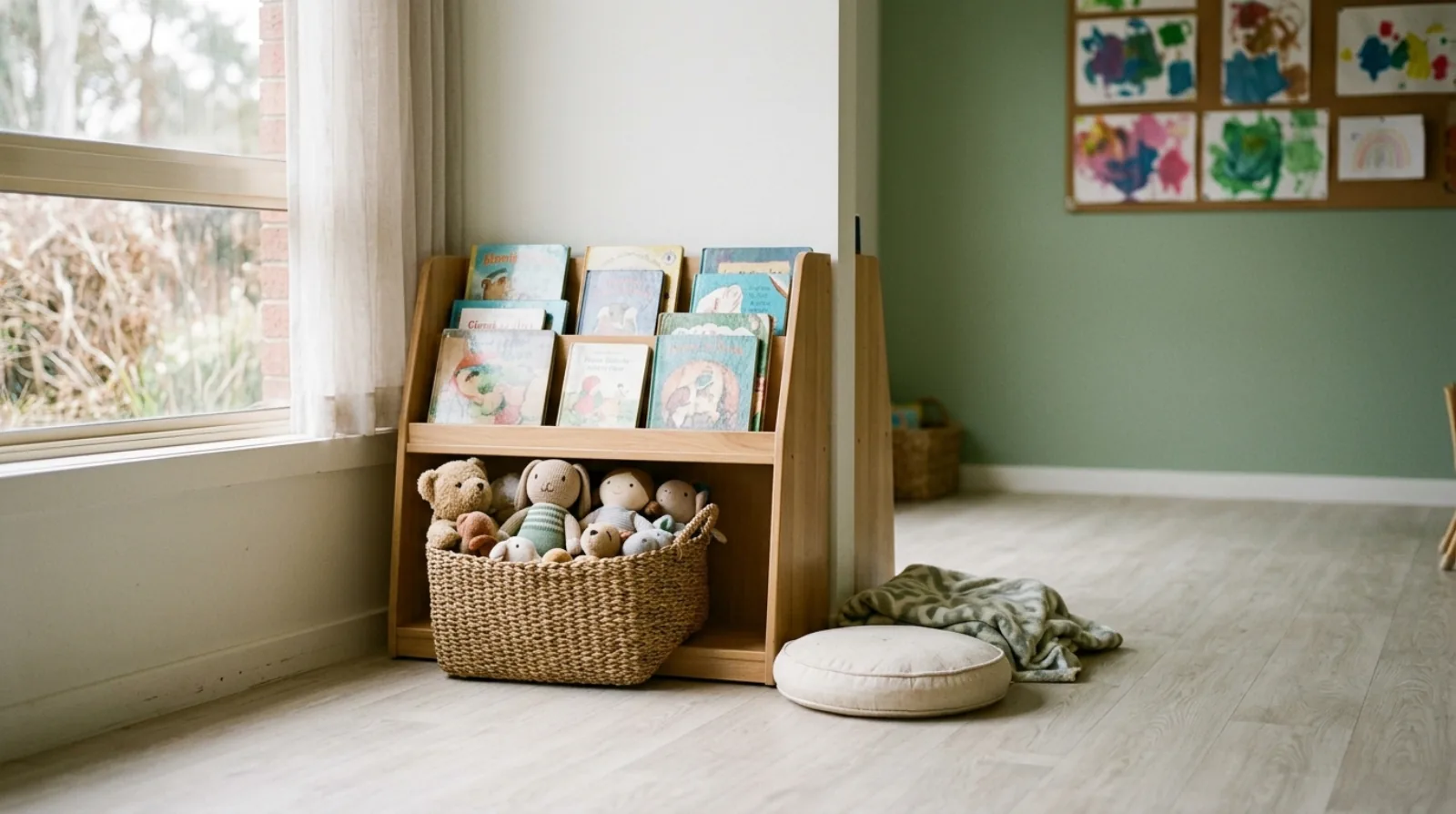
There is no screen time in the day here. The daycare day is built around play, movement, art, music, stories and outdoor time. A child in care from early morning to late afternoon has already spent the bulk of their waking hours with no screen in them.
Whatever happens between pick-up and bedtime is the entire screen question for that child.
For most families that turns a large, vague worry into a small, specific one about a two or three hour window, which is a much easier thing to manage. Many parents are further ahead on this than they feel.
What the evidence is clearer and less clear about
Being honest about the state of the evidence matters, because confident claims in both directions are easy to find.
Reasonably well supported: screens near bedtime are associated with harder settling and worse sleep. Background television reduces the amount and quality of talk in a room, including talk between adults and children who are not watching it. Very young children learn considerably less from a screen than from a person. Screens used as the routine way to end distress give a child less practice at recovering from distress.
Much less settled: precise thresholds, and strong claims about attention. The specific number of minutes at which harm begins is not something the research supports, which is one reason recommendations use words like "about an hour or less" rather than a hard cutoff.
The Canadian Paediatric Society's own position statement on screen time and preschool children sets out the state of the evidence in more detail for anyone who wants the longer version.
The four things that matter more than the number
What it displaces. Sleep, movement, play and conversation are the four things worth protecting. A screen that takes from those is costing something. A screen that fills a gap where none of them were going to happen is costing much less.
Whether an adult is present. The same programme watched beside an adult who asks and answers questions does considerably more than the same programme watched alone. If screen time is going to happen, joint screen time is a real upgrade.
When it happens. Not in the hour before bed, not in the bedroom, not during meals. Those three rules solve most of the practical problems without requiring a stopwatch.
Whether it is the default answer to feelings. This is the one I would watch hardest. Self-regulation develops through repeatedly being upset and coming back from it with adult support. A screen ends the feeling immediately and reliably, which is exactly why using it every time removes the practice.
Ending screen time without the fight
The daily argument is usually about the transition rather than the screen.
Warn before the end rather than at the end. Finish at a natural boundary, the end of an episode instead of mid-scene. Name what happens next, because a child moving toward something copes better than a child moving away from something.
And keep the rule stable. A fixed rule that does not bend under negotiation produces fewer arguments across a month than a flexible one, because a rule that sometimes moves is worth pushing on every single time.
Our post on transitions during the daycare day covers why these moments are difficult in general, and the same techniques apply at home.
On shows in another language
Parents raising a bilingual child often hope that content in the target language will do some of the work.
It does much less than people expect, for the reason set out above. A child learns language from people who respond to them, and a recording cannot. Content in a language a child is already hearing from real people can reinforce it. It will not create the language on its own.
What does work is speaking the language yourself, and using it in situations the child cares about. Our post on speaking a second language at home and our guide to raising a bilingual child go through the practical strategies.
Why the centre is built this way
The British Columbia Early Learning Framework, the Province's guidance for early years practice in its 2019 revision, describes children as capable and active participants in their own learning, and organises practice around living inquiries that assume children investigating materials, places and each other.
A screen is a poor fit for that, not because of a rule against it, but because almost everything the framework describes involves a child acting on the world and seeing what happens. The room is set up for that instead: materials within reach, long stretches of time, and adults who narrate and ask rather than present.
Our post on a day at our centre, hour by hour walks through what that actually looks like from drop-off to pick-up.
The version to take away
Under two, skip it apart from video calls with people who love them. Two to five, about an hour or less of routine use.
Then stop counting and ask the better question. What would this time otherwise have been, is an adult in it, is it near bedtime, and is it how we end every difficult feeling.
If your child spends the day here, the honest answer is that most of their waking hours are already screen-free and the remaining decision is a small one.
Frequently asked questions
What does the Canadian Paediatric Society actually recommend?
For children under two, screen use is not recommended, because they do not learn from it, with the exception of video chatting with caring adults such as extended family. For children aged two to five, the recommendation is to limit routine or sedentary screen use to about an hour or less per day. These come from the Canadian Paediatric Society's guidance on screen use and young children.
Why is video chat treated differently?
Because it is a real conversation with a real person who responds to the child. The Canadian Paediatric Society names video chatting with caring adults, such as extended family, as the exception for children under two. A grandparent who answers, waits, laughs at the right moment and responds to what the child does is providing back-and-forth interaction, which is the thing very young children learn language from.
Does my child get any screen time at the centre?
No. The daycare day here is built around play, movement, art, music, stories and outdoor time rather than screens. For a family using full-time care, that means a long stretch of the day already has no screen in it, and the only screen time to think about is what happens at home.
Is educational content better than other content?
It is usually better than fast-cut entertainment, and it is still a screen rather than an interaction. The strongest predictor of whether a young child gets anything out of screen content is whether an adult is watching with them and talking about it. A programme watched alone teaches much less than the same programme watched beside someone who asks questions and answers them.
What if we go over an hour some days?
A long flight, a sick day, or an afternoon when a parent has to get something done are not developmental emergencies. The recommendation describes routine use rather than every individual day. What matters more than any single day is the ordinary pattern across a week, and whether screens are displacing sleep, movement, play and conversation over time.
Should screens be used to calm a child down?
Use it sparingly. A screen ends a difficult feeling quickly and reliably, which is exactly the problem, because the child does not practise getting through the feeling with an adult's help. Self-regulation develops through repeated experience of being upset and coming back from it. A screen every time removes the practice.
Do screens affect sleep?
Screens close to bedtime are widely associated with harder settling and worse sleep in young children. The practical rule most families find workable is no screens in the last hour before bed and none in the bedroom at all. Our post on sleep regressions covers what else affects a young child's sleep.
What about screens during meals?
A meal is one of the few reliable stretches of conversation in a busy day, and a screen removes it. Eating in front of a screen also makes it harder for a child to notice their own hunger and fullness, since attention is somewhere else. Keeping meals screen-free is a smaller change than it sounds and protects a good deal of talking.
How do I take a screen away without a meltdown?
Warn before the end rather than at the end, and end at a natural stopping point such as the finish of an episode rather than mid-scene. Naming what comes next helps, because the difficulty is usually the transition rather than the screen. A predictable rule that does not change based on negotiation produces fewer arguments over time than a flexible one.
My child watches shows in another language. Does that help them learn it?
Much less than people hope. Young children learn language from back-and-forth interaction with a person who responds to them, and a recording cannot respond. Screen content in another language can support a language a child is already learning from real people, and it does not substitute for those people. Our post on speaking a second language at home covers what does work.
Before you visit
If you want to see what fills a day with no screens in it, come and look. Tours run about thirty minutes by appointment. Contact us to arrange one, or read about our approach first.
Copies a ready-written post, then opens LinkedIn.