August 28, 2026
What happens on your child's first day at daycare
The first day is shorter and simpler than most parents expect. Here is the visit that comes before it, the paperwork British Columbia requires, what the goodbye at the door looks like, and how you hear from us once you have gone.
By Tracy, Owner and Principal
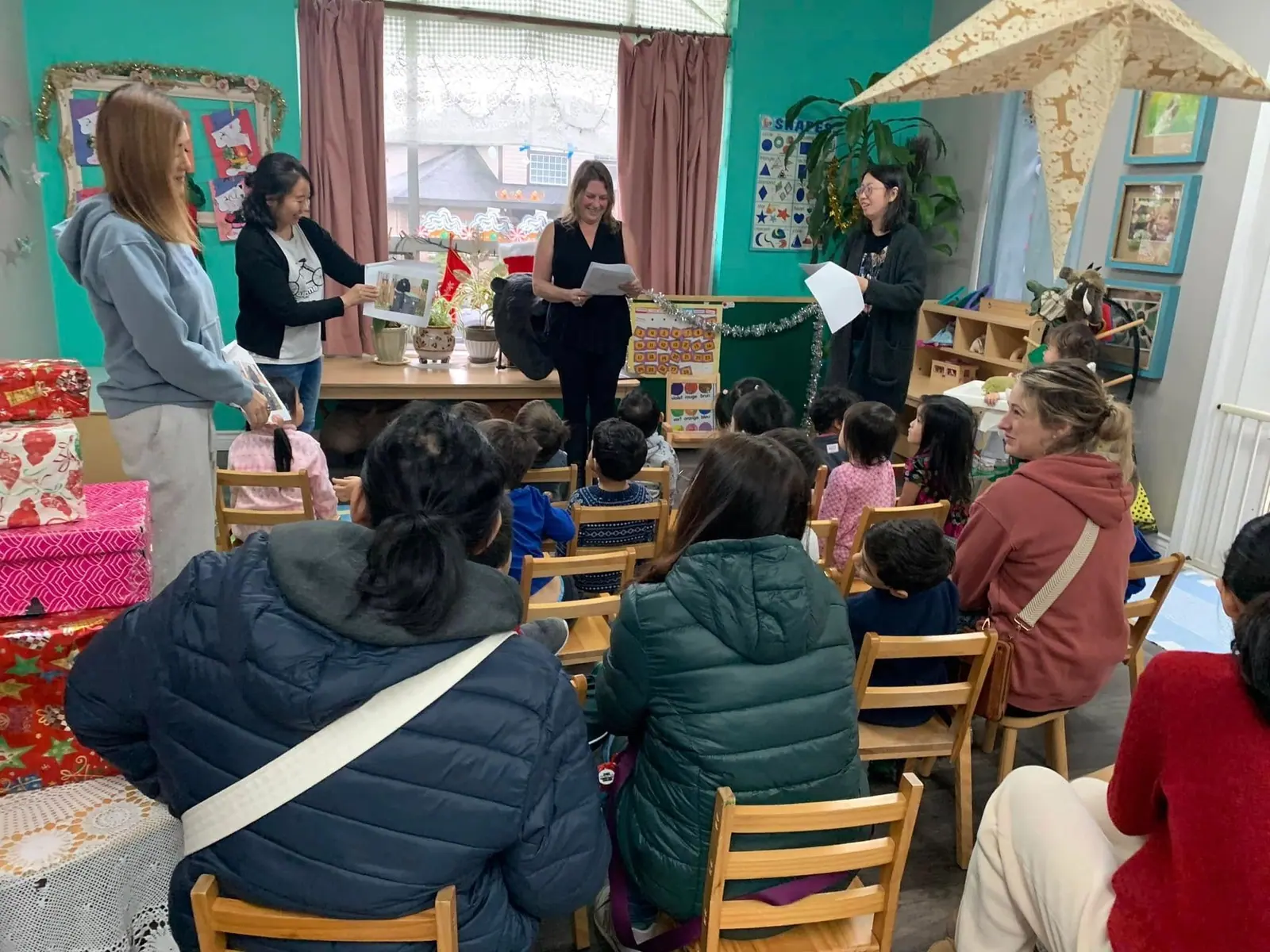
The first day is shorter than most parents picture it. There is a bag to hand over, a goodbye at the door that we ask you to keep brief, and then a normal morning that your child joins partway through. Almost everything that makes the day go well happens before it, in a visit and a conversation.
The short version
You arrange a visit before the start date. You tell us what we need to know about your child. On the morning itself you say goodbye warmly and clearly, then leave. We text you. If your child is having a hard time, we call.
That is the whole shape of it. The rest of this page is the detail behind each of those steps.
The visit that comes first
Families are welcome to arrange a visit with their child before the official start date. This is not the tour. The tour is for you, and it takes about thirty minutes. This visit is for your child.
The point is to make the room ordinary before it has to be ordinary. Your child meets the educators while you are still standing there. They see where the coats go, where the bathroom is, what the floor looks like. On the first real morning, none of that is new. Only your leaving is new, which is enough for one day.
If you cannot arrange a visit, the first day still works. It is simply one more unfamiliar thing at once.
Bring your child to the tour as well, if you can. Families are encouraged to, and it turns a half hour that was about you into a half hour your child has already spent in the building. Tours are by appointment, and the best time is outside drop-off, pick-up, outdoor play and nap, so the rooms are doing something your child can actually watch.

What we need from you before day one
Two separate lists apply here, and they are worth keeping apart in your head.
The first is what British Columbia requires any licensed centre to hold. Under section 57 of the Child Care Licensing Regulation, we must keep a current record for each child that includes their name, sex, date of birth, medical services plan number and immunization status, the date they enrolled, a daily attendance record, and the name and telephone number of a parent, a medical practitioner and an emergency contact. The record also has to capture any illness, allergy or medical disability you disclose, any medication given, and any special instruction about diet, medication or taking part in activities that you give us in writing and we agree to.
The same section requires your written consent for two things: for us to call a medical practitioner or an ambulance in case of accident or illness, and for us to release your child to somebody other than you.
The second list is what we ask for because it makes the day better, not because a regulation says so. Your child's daily routine at home. How they sleep and how they eat. Toileting or diapering needs. What they are interested in at the moment. Whether there is a comfort item and what it is. The language you speak at home. Anything about development or feelings that would help an educator understand a reaction.
Nobody expects you to remember all of that at the door on a Monday morning. It is a conversation, and it can happen at the visit.
One item is worth saying twice, because parents get it wrong kindly and often: medication never goes in a child's bag. It is handed directly to an educator, with the written authorization and instructions. The regulation requires that a child's medication is not accessible to any child, and a backpack on a low hook is accessible to everyone.
The goodbye at the door
A designated educator or the centre administrator meets families each morning, takes any update from you, and helps your child into the classroom. On a first day that person will usually be watching for you.
What we ask of you is small and hard. Stay calm. Give a clear, reassuring goodbye. Tell your child you will come back later, and say when in terms they understand, such as after nap or after snack. Then go.
What we ask you not to do is a shorter list and it matters more. Do not leave without saying goodbye. Do not stretch the farewell out. Do not come back into the room after you have left. Try not to let your child see that you are anxious, even though you are.
Leaving without saying goodbye is the one that causes the most damage, and it is the one most often suggested by well-meaning friends. It works once. After that the child watches you all morning, because you have shown them that you might disappear.
What happens after you leave
Your child cries, or they do not. Either is normal and neither predicts the rest of the week.
The educators comfort them and then move them gently into something familiar, which usually means an activity they were already watching. Most children settle a short time after the parent has actually gone. The transition is often faster than the goodbye was.
You will hear from us by text message or phone. If your child stays distressed, or if the day is clearly not working, we call you rather than waiting for pick-up.
Your update at pick-up is a spoken one. We do not issue written progress reports on a schedule. An educator tells you how the day went when you collect your child, and you can ask for a private meeting whenever you want a longer conversation than the doorway allows.

Shorter days first
Settling in is flexible and shaped around each child. Where it helps, families begin with shorter visits and increase the hours gradually until the child is comfortable with a full day.
There is no fixed number of days for this and we will not give you one. Some children are settled inside a week. Some take considerably longer, including children who seemed fine on day one and struggle in week three. Both are ordinary.
What we ask is that you tell us early when something is not working, rather than waiting to see whether it improves on its own. A change to the arrival time, a different educator at the door, or a shorter afternoon is easy to arrange in week one and harder to unpick in week six.
If your child is under three
The first day looks a little different for a younger child, and the difference is set partly by regulation rather than by us.
A centre providing care to any child younger than 36 months has to give them a separate sleeping area, away from the activity area. Sleeping furniture is used by one child at a time and has to suit that child's size and stage. Children are positioned for sleep on their back only, unless the child can roll over without help. Those are requirements under the Child Care Licensing Regulation, not house preferences, and they apply everywhere in the province.
In practice this means a younger child spends part of their first day in a room you may not have walked through on the tour. Ask to see it. It is the space they will be in when they are least able to tell you about it afterwards.
Group size is different too. A multi-age group holds at most eight children. If your child is joining one of those, the number of faces they have to learn on day one is small, which is usually easier than it sounds on paper.
The part nobody enjoys
Here is the honest trade-off. A short goodbye is better for your child and worse for you. You will walk to the car with the sound of your own child crying still in your ears, and you will have no information for about twenty minutes.
That is a real cost and we are not going to describe it as anything else. What we can do is make the twenty minutes as short as possible, which is why the text message exists.
Some families would rather have a live camera feed or an app that logs every nap and nappy with a timestamp. We do not run one. What you get instead is a person who can tell you why the morning went the way it did. Which of those two you prefer is a fair thing to weigh when you are choosing a centre.
Frequently asked questions
Can I stay with my child on the first day?
You can arrange a visit with your child before the official start date, and we encourage it. On the first day of care itself we ask for a warm but brief goodbye. Staying in the room on day one usually makes the goodbye harder, because the child waits for you rather than settling with the educator.
How long should I stay at drop-off on the first day?
A few minutes. Hang the coat, hand over the bag, say goodbye clearly, and go. Most children settle faster once the parent has left than they do while the parent is still standing in the doorway. A long goodbye stretches out the hardest part instead of shortening it.
Will someone tell me how my child is doing during the day?
Yes. We update families by text message or phone, and we will contact you if your child stays distressed or needs extra support. You do not have to wait until pick-up to find out how the morning went, and you do not need to ask us to do it.
How many days does settling in usually take?
There is no fixed number. Settling in here is flexible and set around each child. Some children are comfortable within a few days and some take several weeks. We start with shorter visits where that helps and build up to a full day at the pace the child sets.
Can we visit the centre before my child's first day?
Yes, and families are welcome to arrange one. A visit before the start date lets your child meet the educators, see the rooms, and get used to the space while you are still there. It gives the first real morning something familiar to attach to.
What should I tell the educators before my child starts?
Your child's daily routine, sleep and eating habits, allergies or medical needs, toileting or diapering needs, interests, comfort items, preferred language, and any developmental or emotional support they need. British Columbia also requires us to hold specific records, which we go through with you.
What happens if my child does not settle at all on the first day?
We contact you. Depending on what would help, that might mean a shorter day, a different arrival time, or a change to the routine we follow at drop-off. A hard first day is common and it is not treated as a sign that the placement will not work.
Should my child start on a Monday or later in the week?
Either works, and there is no rule about it. Some families prefer a Wednesday or Thursday start so the first stretch is only two or three days before a weekend. Others prefer a Monday so the week runs in its normal order. Tell us what you would like.
Before you visit
If you are still deciding, look the centre up first. Fraser Health publishes a list of every licensed facility in this area, and our own entry on it is set out in how to check a daycare's licence.
We are at 1103 Confederation Drive, in the Citadel neighbourhood of Port Coquitlam. You can read about our programs, the centre itself and the people who work here, and the day is set out hour by hour on our schedule and walked through block by block in a day at our centre. When you are ready, come and see it, and bring your child.
Copies a ready-written post, then opens LinkedIn.