Part 3 of 6
The Child Care Fee Reduction Initiative, and why you may not notice it
The Child Care Fee Reduction Initiative pays participating licensed providers to lower their published fees. Families do not apply, which means many never realise it is happening or check whether their centre takes part.
By Tracy, Owner and Principal
This is the program most families in British Columbia benefit from and fewest have heard of.
It requires nothing from you. No form, no income test, no renewal. The Province pays participating licensed providers, and those providers charge every family less. The saving appears as a smaller number on an invoice, with nothing to indicate that a program produced it.
Which is efficient, and has one awkward side effect: a family that does not know the program exists cannot tell whether the fee they were quoted already includes it.
What it is worth
These are the maximum monthly reductions published by the Province, read on 25 August 2026.
| Age of child | Group care | Family child care |
|---|---|---|
| Under 36 months | $900 | $600 |
| 3 years to kindergarten | $545 | $500 |
| Kindergarten | $320 | $320 |
| Grades 1 to 12 | $115 | $145 (family or in-home) |
| Preschool | $95 | Not applicable |
Read the first row against the last and the shape of the program is obvious. Care for the youngest children costs the most to provide and attracts the largest reduction. From three years the amount drops by around 40 per cent, and it falls again at school age.
The single most useful question to ask a centre
"Is the fee you have quoted me before or after the fee reduction?"
At a participating centre, the published fee usually already has the reduction applied. So a parent who takes a quoted fee and subtracts $900 in their head will build a budget that is $900 a month too optimistic.
The reverse mistake also happens. A parent compares a participating centre's reduced fee against a non-participating centre's full fee and concludes the second is far more expensive than it really is once other funding is counted.
Ask the question in those exact words, and ask for the answer in writing along with what else is charged separately.
How to check whether a centre participates
The Province provides two tools: the fee reduction estimator and the child care map at maps.gov.bc.ca.
There is an important caveat on both, stated by the Province itself. Providers with an application in progress, including mid-term fee increase requests, will not appear in the search results. A centre that is enrolling, or that has asked to change its fees, temporarily drops out of the search.
So an absence from the results is not proof that a centre does not participate. The Province's own advice is to contact the provider and ask whether they are enrolled or plan to enrol.
In the Tri-Cities, almost everyone participates
The Province publishes an open dataset of licensed child care locations, and it records fee reduction participation for each one.
Downloaded on 25 August 2026, that dataset lists 396 licensed facilities across Coquitlam, Port Coquitlam, Port Moody and Anmore, and records 391 of them as participating in the Child Care Fee Reduction Initiative. Five are not.
That has a practical consequence for how you shop locally. Participation is close to universal here, so it will not help you tell one centre from another. What still varies is the underlying published fee, whether the site is approved for $10 a Day, and what your own household qualifies for under the Affordable Child Care Benefit.
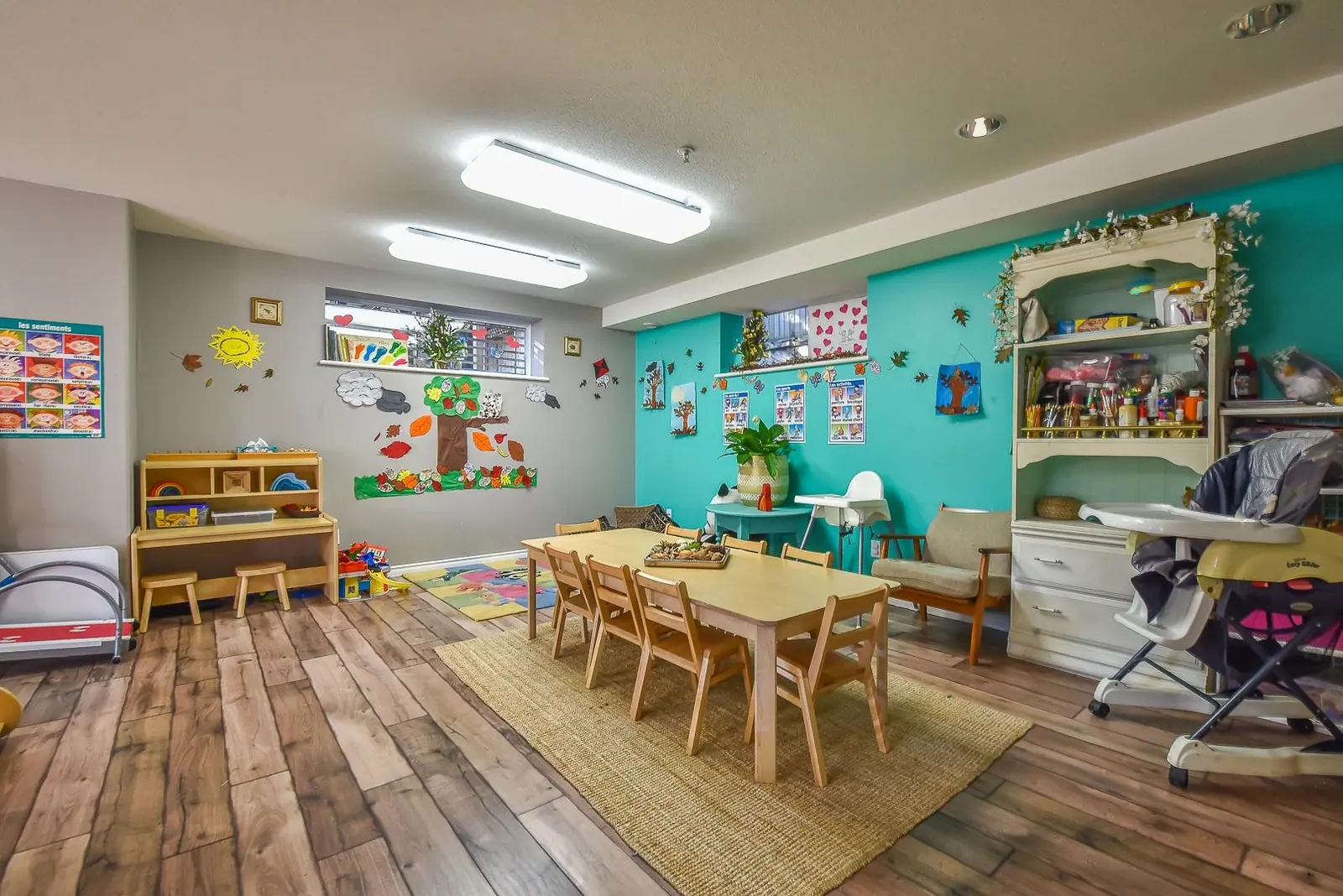
This centre is recorded in that dataset as participating. That statement comes from the Province's data rather than from us, which is the only basis on which it is worth publishing.
How the reduction reaches you
The mechanism is worth spelling out, because it explains why the program is invisible.
The Province pays the participating provider. The provider is then required to charge families less than it otherwise would. Nothing passes through a family's hands, no claim is filed, and no separate line necessarily appears on an invoice showing what the reduction was worth.
The result is a lower number where a higher number would have been. That is efficient and it removes every barrier that stops eligible families claiming a benefit they qualify for. It also means most families have no way of seeing the program working, which is why the question about whether a quoted fee is before or after the reduction matters so much.
Why the amounts differ by age
The reductions are not arbitrary. They track the cost of providing care, which is driven almost entirely by staffing.
Under Schedule E of the Child Care Licensing Regulation, care for children under 36 months requires far more adults per child than care for older children. Group Child Care (Under 36 Months) requires an infant and toddler educator for every four children. Group Child Care for 30 months to school age allows one educator for eight.
So a room of infants needs roughly twice the staff of a room of preschoolers, and the reduction for under-36-months care is roughly two-thirds larger than for the three-to-kindergarten band. The funding follows the ratio. Ratios and group sizes sets out the whole staffing table.
That also explains the shape of the drop at three. Nothing changes about the family, and the amount of staffing the law requires falls sharply, so the funding falls with it.
The $200 floor
One rule limits how far the reductions can go.
The Province states that out-of-pocket fees for families, after the applicable fee reductions, will not be reduced below $200 a month for full-time care, with limited exceptions.
So stacking the fee reduction with the Affordable Child Care Benefit does not drive a full-time bill to zero. It is also why the $10 a Day program lands at $200 rather than at nothing: the two programs are converging on the same floor by different routes.
How the three programs stack works through the combinations in detail.
Stacking with the Affordable Child Care Benefit
The Province states that families with a household income of up to $111,000 may also apply to the Affordable Child Care Benefit for additional savings on top of the fee reductions passed on at participating centres.
The order matters for understanding what you see. The fee reduction lowers the centre's fee for everybody. The Affordable Child Care Benefit is then applied to your family's share of that reduced fee, usually as a payment made to the provider, with you paying the balance.
So a family claiming both sees one reduced fee and one further deduction, rather than two separate refunds.
Why it exists in this form
The design is worth understanding because it explains the invisibility.
Paying the provider rather than the family removes the application barrier entirely. Nobody misses out through not knowing, not filing, or not renewing. That is the opposite trade-off from the Affordable Child Care Benefit, which is targeted by income and therefore has to be claimed.
The cost of that design is transparency. A program nobody applies for is a program nobody thinks about, which is why so many families cannot say whether their centre participates.
What happens when a centre changes its fees
Participating providers do not set fees entirely freely, because the Province is funding part of the gap. Fee increases are subject to the program's rules, and providers with a mid-term fee increase request in progress temporarily disappear from the Province's search results while it is processed.
For a family, that has two practical consequences.
A centre missing from the search may simply be mid-request. Do not read absence as non-participation without asking.
An increase should come with an explanation. Ask your centre what changed, whether the reduction applied to your account is affected, and when the new figure takes effect. A participating centre has been through an approval process for that change and can explain it.
If your centre is one of the five that does not participate
In the local dataset, five of 396 facilities are recorded as not participating. That is not a mark against them, and it is worth understanding rather than assuming.
Ask the centre directly whether it is enrolled, plans to enrol, or has chosen not to, and why. Then compare properly: a non-participating centre's fee is a full fee, and the fee at a participating centre is usually already reduced, so the two numbers are not measuring the same thing. The Affordable Child Care Benefit is available either way, since it follows the family rather than the centre.
What to do with this
Three things, and they take about ten minutes.
Check participation for every centre on your shortlist, using the estimator or the map, and phone any centre that does not appear.
Ask whether the quoted fee is before or after the reduction, in writing.
Apply for the Affordable Child Care Benefit if your household earns up to $111,000, because that one will not arrive on its own. See the Affordable Child Care Benefit.
Next, how the three programs stack.
Questions parents ask
Frequently asked questions
What child care costs in BC