September 29, 2026
The hand strength behind holding a pencil, and how children build it
Fine motor control develops from the shoulder outward, which is why cutting, threading, playdough and doing up a zip matter more than worksheets. What pencil grip actually does before school, and what kindergarten readiness really covers.
By Tracy, Owner and Principal
Somewhere around a child's fourth birthday, a particular worry arrives. They cannot write their name yet. School is coming. Somebody's cousin's child could write theirs at three.
The pencil is the visible part of a much larger structure, and the structure gets built somewhere else entirely. Understanding where is the difference between a useful year and a year spent on activities that were never going to help much.
Control develops from the middle outward
This is the single most useful idea in this whole area, and it is not widely known outside early years settings and paediatric therapy.
Motor control develops from the centre of the body toward the extremities. Trunk and shoulder stability come first. Then the elbow. Then the wrist. The small muscles of the hand and fingers are last.
The reason is mechanical. To draw a controlled line, a child's shoulder has to hold the arm steady in space while the wrist and fingers make small precise movements. If the shoulder cannot stabilise, the whole arm moves with every attempt, and no amount of finger practice fixes that, because the problem is further up.
Which leads somewhere counterintuitive. A four-year-old hanging from a bar, pushing a laundry basket across the floor, crawling through a tunnel, or carrying a bucket of water is doing something that supports handwriting. Whole-body play is part of the foundation rather than a distraction from the real work.
Any centre with an outdoor space and climbing equipment is developing writing hands, even though nobody in the yard is holding a pencil.
What fine motor skills actually cover
The Canadian Paediatric Society describes fine motor skills as the skills that use the small muscles in the hands and fingers, and lists using hands to eat, draw, dress, play and write.
Notice how much of that list has nothing to do with school. Eating with a fork. Getting a jacket on. Turning the pages of a book. These are not preparation for the real skill. They are the skill, in the ordinary settings where a child gets dozens of repetitions a day without anyone organising it.
That reframes the question a parent should be asking. Rather than how much drawing practice a child is getting, ask how many chances a day the child gets to use their hands on real tasks.
The activities that do the work
The most effective fine motor activities look nothing like writing, and children stay with them far longer than they will stay with a worksheet.
Scissors. Cutting is one of the best fine motor activities available. It requires opening and closing the hand repeatedly against resistance while the other hand turns the paper. Child-safe scissors and a stack of paper nobody needs is enough. Cutting up an old magazine counts.
Threading. Beads onto a lace, pasta onto string, buttons onto a shoelace. It demands a pincer grip, hand-eye coordination and the two hands doing different jobs at the same time.
Playdough and clay. Squeezing, rolling, pinching and pulling apart build hand strength directly, and the resistance is what makes it work. The Canadian Paediatric Society lists playing with clay among suitable toddler activities.
Tearing paper. Easy to dismiss and genuinely useful. Tearing needs both hands working in opposition, with control.
Tongs and tweezers. Moving pompoms or dry pasta from one bowl to another with kitchen tongs uses the same grip pattern a pencil later needs.
Drawing and painting. The Canadian Paediatric Society suggests drawing with large crayons on blank paper, chalk and a chalkboard, and painting with large paintbrushes. Blank paper matters. Open-ended drawing gives a child more room than a colouring page with lines to stay inside.
Self-care. Zips, buttons, snaps, socks, shoes, lunch containers. Every one is fine motor work with a real reason attached, which is why children persist with it. Letting a child do these things themselves takes longer in the morning and it is the practice.
Pencil grip, and why not to fight about it
Grip matures through recognised stages across several years. A very young child typically holds a crayon in a whole-hand grasp with the arm doing the moving. Over time the grasp moves down the hand, the fingers take over from the arm, and eventually a mature grip with the fingers controlling the movement appears.
That progression takes years, and it depends on the strength and stability described above rather than on being shown the right way to hold a pencil.
Pushing an adult grip on a hand that is not ready usually produces one of two outcomes. The child grips harder and tires quickly, because they are compensating for stability they do not yet have. Or the child decides drawing is an unpleasant activity where an adult corrects them, and stops choosing it. The second is worse, because the practice they were getting voluntarily disappears.
More useful: offer short, chunky crayons, which naturally encourage a finger grip rather than a fist. Draw on a vertical surface sometimes, such as paper taped to a wall or an easel, because that position builds shoulder and wrist stability. And keep drawing enjoyable, so the child keeps doing it.
If you have a persistent concern, raise it with your child's educator or health care provider. That is different from a daily correction at the kitchen table.
Drawing comes before writing
There is a sequence here worth knowing, because it stops the worry about letters.
Children begin with marks. Then scribbles that become more controlled. Then closed shapes, then recognisable shapes such as circles and crosses. Then shapes that look like letters. Then letters.
Each stage rests on the one before. A child who draws frequently is moving through it. The order is more informative than the age, and as the Canadian Paediatric Society puts it, all children are different and develop skills at different times, so it is normal for a child to be behind in some areas and ahead in others.
A child at four who fills pages with drawings is doing what leads to writing, whether or not any letters have appeared yet.
What kindergarten readiness actually means
This is where a lot of anxiety could be redirected usefully.
The Early Development Instrument is a questionnaire completed by kindergarten teachers each February for the children in their classrooms, used in British Columbia to understand how children are doing across communities. It looks at five areas: physical health and well-being, social competence, emotional maturity, language and cognitive development, and communication skills and general knowledge.
The physical domain includes gross and fine motor skills, physical independence, and physical readiness for the school day. Physical independence is a meaningful item. It covers things like managing your own coat, your own shoes, and your own washroom needs.
Four of the five domains are about something other than academic skill. Kindergarten teachers, asked what they most want from arriving children, tend to name the same things: managing belongings, separating from a parent, following a group routine, asking for help, and staying with something that is hard.
Our post on what your child actually learns at daycare covers that wider picture, and our guide to early learning and play sets out how play develops these capacities.
How this looks across a centre day
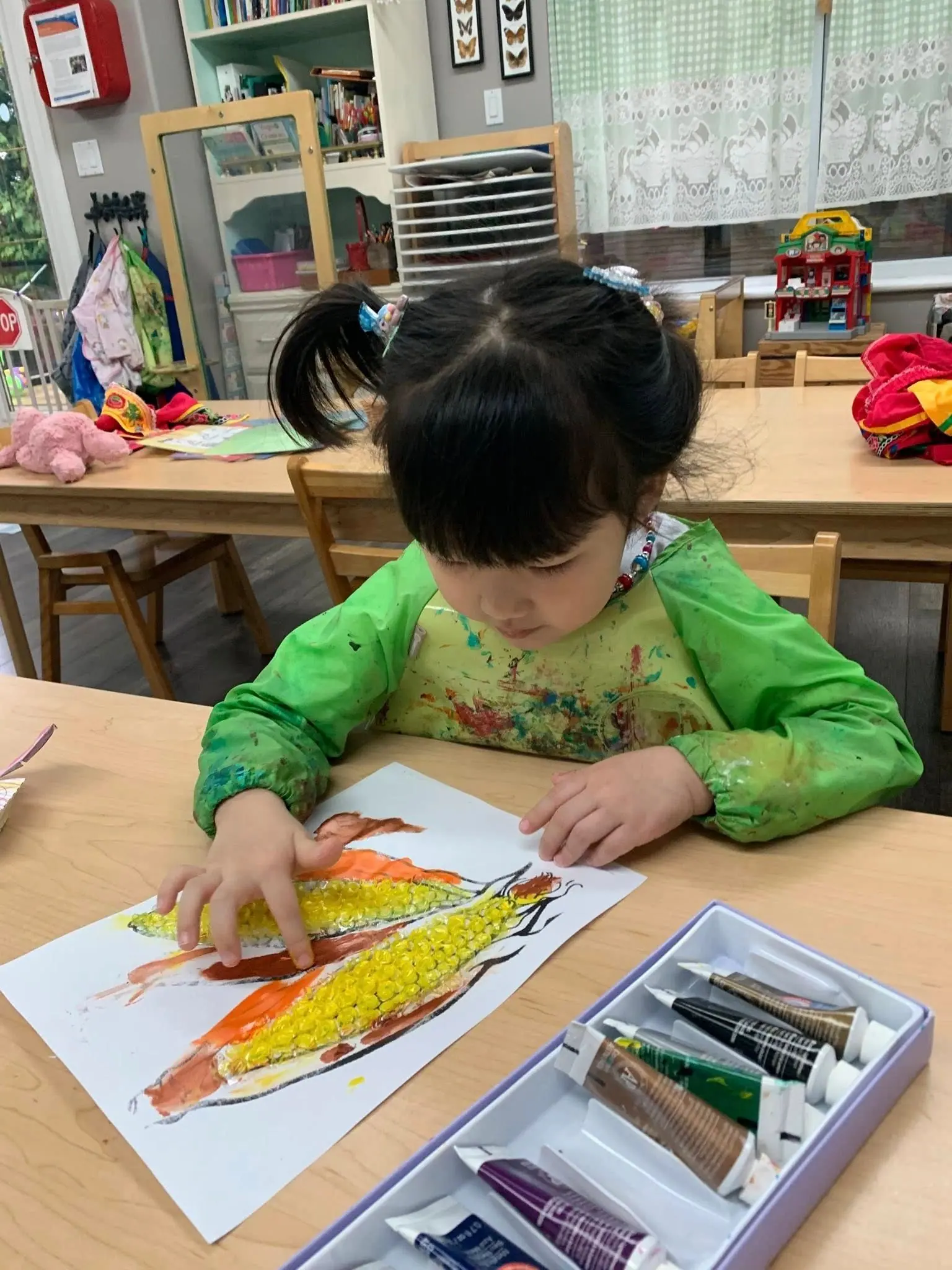
Children here do art including painting and crafts, which is fine motor work embedded in something children want to do rather than an exercise.
They also practise self-care, and the centre has child washrooms, which matters more than it sounds. A washroom sized for children lets them manage taps, soap and their own clothing without an adult doing it, and every one of those is hand work with an obvious purpose.
Artwork mostly comes home. Holiday-themed pieces usually go home the same day. Other selected pieces may be displayed at the centre first, then returned to families or collected in a personalized art book given to the family.
Keep some of it. A drawing from September beside one from June shows the progression in control more clearly than any assessment would, and it is a better answer to the worry about whether a child is developing than a comparison with someone else's child.
The Early Learning Framework, British Columbia's provincial guidance for early years practice, describes materials as things that invite action, and clay, paint, brushes and paper as things that draw children in. That is the design principle. Put good materials in front of children, give them time, and the practice happens because they want it to.
What to do with the year before school
If your child is starting kindergarten next September, the useful list is short.
Let them do their own zip, even when you are late. Keep scissors and paper somewhere reachable. Have playdough. Draw on blank paper rather than in colouring books, at least some of the time. Get them climbing and hanging and carrying things. Let them serve themselves at meals.
And skip the worksheets. A child who can manage their own coat, ask an adult for help, sit with a group for a story, and keep trying when something is difficult is ready for kindergarten. The letters follow, once the hands are ready to make them. Our programs are built around exactly this kind of everyday practice rather than around drills.
Frequently asked questions
What are fine motor skills, exactly?
The Canadian Paediatric Society describes fine motor skills as the skills that use the small muscles in the hands and fingers, including using hands to eat, draw, dress, play and write. They cover far more than writing. Every time a child does up a button, turns a page, picks up a small object or manages a fork, they are using and building the same set of muscles and the same hand-eye coordination that a pencil later requires.
Why does gross motor play matter for handwriting?
Control develops from the centre of the body outward, so the shoulder and trunk have to be stable before the wrist and fingers can work precisely. A child hanging from a bar, pushing a heavy box, crawling through a tunnel or carrying something awkward is building the stability that later lets the hand move accurately while the arm stays still. Time spent moving the whole body is not time taken away from handwriting practice.
Should I correct my child's pencil grip?
Grip matures through recognised stages over several years, and a young child holding a crayon in a whole-hand grasp is usually doing what their hand is currently ready for. Insisting on an adult grip too early tends to produce tension, frustration and a child who avoids drawing altogether, which costs more than the grip gains. Offering short, chunky crayons and plenty of enjoyable drawing does more than correction. Raise a persistent concern with your child's educator or health care provider rather than turning it into a daily battle.
What activities build a writing hand best?
Cutting with child-safe scissors, threading beads onto a lace, rolling and squeezing playdough, tearing paper, picking objects up with tongs or tweezers, and building with small blocks. Self-care counts too: zips, buttons, snaps and pulling on socks all build the same strength. The Canadian Paediatric Society suggests drawing with large crayons on blank paper, playing with clay, chalk and a chalkboard, and painting with large paintbrushes.
Are worksheets useful before kindergarten?
They are a narrow use of a young child's time. A worksheet practises one specific movement in a seated position for as long as a child will tolerate it, which is usually not long. Cutting, threading and playdough build the underlying strength and coordination that all letter formation later depends on, and children stay with them far longer because they are genuinely interesting. Building the foundation is what makes writing easier when it comes.
When do children start forming letters?
Scribbling and drawing come first, and they are the real groundwork. A child moves from marks, to controlled scribbles, to shapes, to shapes that resemble letters, and eventually to letters. Each stage needs the previous one. A child who draws a lot is doing the thing that leads to writing, and the sequence matters more than the age at which any particular step arrives.
Does my child need to write their letters before kindergarten starts?
The Early Development Instrument used across British Columbia measures kindergarten readiness across five domains, one of which is physical health and well-being, including gross and fine motor skills and physical independence. Writing letters is not the gate. What consistently matters more is whether a child can manage their own coat and shoes, separate from a parent, follow a group routine, and keep going when a task is hard.
What does the Early Development Instrument actually measure?
It is a questionnaire completed by kindergarten teachers each February for the children in their classrooms, used in British Columbia to look at how children are doing across whole communities rather than to assess individuals. It covers five areas: physical health and well-being, social competence, emotional maturity, language and cognitive development, and communication skills and general knowledge. The physical domain includes gross and fine motor skills, physical independence, and physical readiness for the school day.
Is my left-handed child at a disadvantage?
No. Left-handed children develop the same underlying strength and coordination in the same order. What helps is practical rather than developmental, such as left-handed scissors when they start cutting, and not seating them where their writing arm collides with a right-handed child's. Hand preference often takes time to settle, so a child who swaps hands at three is doing something ordinary.
What happens to my child's artwork at the centre?
Holiday-themed artwork usually goes home the same day. Other selected pieces may be displayed at the centre first, then returned to families or collected in a personalized art book that is given to the family. Timing varies with the activity. Keeping some of it over time is worth doing, because a year of drawings side by side shows the progression in control far more clearly than any single piece.
Before you visit
If your child starts kindergarten next year and you want to know what they are working on with their hands, ask us. Educators see it daily and will tell you plainly. Contact us to arrange a visit and you can see the art table, the materials and the child washrooms for yourself.
Copies a ready-written post, then opens LinkedIn.