August 31, 2026
Naps at daycare, and what happens when your child has stopped napping
Every child here gets a rest period, and children who no longer sleep do quiet activities instead. Here is where children sleep, what British Columbia requires of a centre's sleep arrangements, what the Canadian Paediatric Society says about sleep by age, and what to do when daycare naps are pushing bedtime later.
By Tracy, Owner and Principal
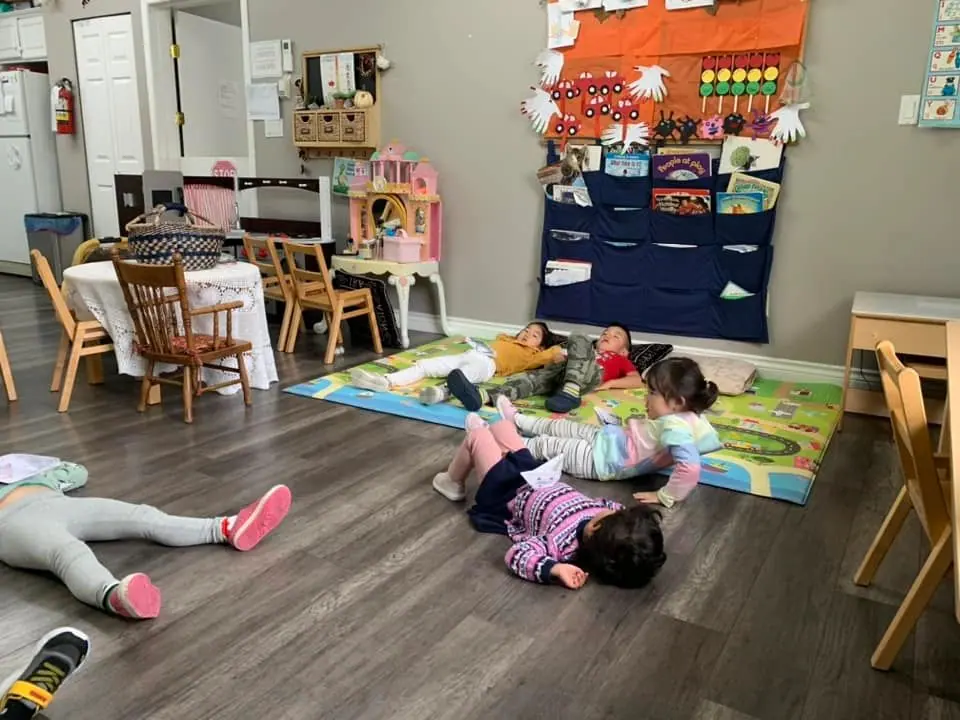
Every child here gets a rest period. Children who still sleep, sleep. Children who have finished with daytime sleep rest for a while and then do quiet activities at a table with an educator.
That distinction between rest and sleep is the answer to most of the questions parents ask us about naps, so it is worth putting first.
Where children sleep
In a designated nap area, on individual sleeping mats.
Families provide the fitted cover for the mat, a blanket, and a comfort item if the child uses one. All of it labelled. The mats themselves belong to the centre.
Two parts of that arrangement are set by regulation rather than preference. Under the Child Care Licensing Regulation, each piece of furniture or equipment for sleeping is used by only one child at a time, and it has to be clean, comfortable and appropriate for the size, age and development of the children using it. A centre providing care to any child younger than 36 months also has to provide a separate sleeping area, located away from any activity area.
There is a third rule that applies to the youngest children: each child is positioned for sleep only on their back, unless the child can roll over without help. That is section 42, and it holds everywhere in the province.
If your child is under three, ask to see the sleeping area on your tour. It is the room they will spend time in when they are least able to describe it to you afterwards, and it is the room least likely to be on a standard walk-through.
What the guidance says about sleep at this age
The Canadian Paediatric Society publishes 24-hour sleep ranges by age. For infants aged 4 to 12 months the range is 12 to 16 hours. For children aged 1 to 2 it is 11 to 14 hours. For children aged 3 to 5 it is 10 to 13 hours. Those totals add naps and night sleep together.
Two things follow from that, and both are the Society's framing rather than ours.
The ranges are wide. A three year old sleeping ten hours and a three year old sleeping thirteen are both inside the same guidance, so a comparison with a cousin or a neighbour's child tells you very little.
The total is what the guidance describes, across the whole 24 hours. That is the reason a long nap here can show up as a late bedtime at home. Nothing has gone wrong. The sleep has moved.
We are not in a position to tell you how much sleep your own child needs, and we will not try. If the totals worry you, that conversation belongs with your doctor.
What a rest period looks like for a child who no longer naps
They lie down for a while. After a suitable rest, they get up and do calm table activities under an educator's supervision: reading, puzzles, drawing.
That is the whole of it, and it is deliberately unexciting. The purpose of the block is a lower-energy stretch in the middle of a long day, which children who have stopped napping still benefit from even when sleep is finished for them.
What does not happen is a child lying on a mat in a dark room for ninety minutes because the schedule says nap. That produces a frustrated child and, quite often, a child who learns to dislike the whole afternoon.
When the nap is pushing bedtime later
This is the most common complaint we hear about naps, and it is a fair one.
The centre follows its daily nap schedule while taking account of each child's age, their sleep needs, and the family's usual routine. If bedtime at home has become difficult, tell us. We will discuss a wake-up time with you and work together on a consistent approach, so that the same plan runs here and at home.
A few things that help when you raise it.
Bring specifics. "He is going to sleep at ten and waking at six" is something we can work with. "He is not sleeping well" is harder to act on.
Say what you have already tried at home, so we are not suggesting it back to you.
Expect it to take a week or two rather than a day. Moving a wake-up time earlier in small steps generally works better than a sudden change, and the first two days can look worse before they look better.
And be aware of the trade. Waking a child earlier here usually means a harder late afternoon at the centre. That is a fair price if bedtime at home improves, but it is a price, and it is your call rather than ours.
The awkward stretch in between
Somewhere between two and four, most children go through a period of napping some days and not others, with no obvious pattern.
That stretch is genuinely hard to schedule around, at home and here. A child who skipped a nap on Tuesday may need one badly on Wednesday. A child who slept two hours may be wide awake at nine.
Our approach through it is to offer the rest and let the child take what they need from it, rather than to decide in advance which category they are in. That means some weeks look inconsistent from the outside. It is the least bad option we have found, and it is the one that keeps the afternoon calm.
If you would rather your child was not offered sleep at all on certain days, tell us and we will follow it. It is your routine and we would rather run yours consistently than run ours around it.
What we need to know before the first nap
Sleep is one of the things we ask families about before a child starts, along with their daily routine, eating habits, allergies and medical needs, toileting needs, interests, comfort items and preferred language.
The sleep part of that conversation is more useful when it is concrete. What time do they usually go down at home, and for how long. What has to happen first: a particular song, a particular position, a blanket held a particular way. Whether they wake easily or wake slowly. Whether they need the room dark. Whether they have ever fallen asleep anywhere other than at home, and how that went.
Nobody expects a perfect account, and children behave differently in a room full of other children anyway. But a first nap goes better when the educator already knows that your child holds the blanket a specific way, rather than discovering it by trial while your child is upset.
Tell us the language too. A child who is settled to sleep with a phrase in Mandarin or French at home will usually settle faster if the same phrase is used here, and several of our educators speak more than one language.
Nap across the three groups
Children are generally organised into three groups across three classrooms, by age, developmental needs and who is actually in that day. Each group has a designated educator, with other educators supporting across the centre, and staff-to-child ratios set by licensing are met at all times.
Nap looks different in each of them, mostly because the children are at different stages. The youngest group has the separate sleeping area the regulation requires. The older group contains more children who have finished with daytime sleep, so the quiet-activity part of the block is busier than the sleeping part.
One consequence worth knowing: when your child moves up a group, their nap usually changes too. That is often the point at which a family notices bedtime shifting at home. It is worth asking us about the new group's rhythm before the move rather than after it.
What we will not do
We will not tell you your child needs more sleep, less sleep, or a different bedtime. That is medical territory and we are not qualified for it.
We will not promise that a nap here means an easier evening at home. Sometimes it does the opposite, for the reason set out above.
And we will not report on a child's sleep in writing on a schedule. There are no written progress reports here. What you get is an educator telling you at pick-up how the afternoon went, and a private meeting whenever you want a longer conversation.
Frequently asked questions
What happens if my child does not sleep at nap time?
They still have a rest period, and after a suitable rest they can do calm table activities such as reading, puzzles or drawing with an educator supervising. Nobody is made to lie on a mat for the whole afternoon waiting for sleep that is not coming.
Can you wake my child up early so bedtime is easier?
Talk to us about it. We follow the centre's nap schedule while considering each child's age, sleep needs and the family's usual routine, and if bedtime at home is a problem we will discuss a wake-up time and work with you on a consistent approach.
Where do children sleep at your centre?
In a designated nap area, on individual sleeping mats. Families provide the fitted mat cover, a blanket and a comfort item if the child uses one, all labelled. Under British Columbia's rules each piece of sleeping equipment is used by one child at a time.
Do I need to bring a blanket and a sheet for nap time?
Yes. Families provide a fitted cover for the sleeping mat and a blanket. The mats are ours. Send the cover and blanket home to be washed as often as you would wash bedding at home, and put your child's name on both.
How long is nap time at daycare?
Nap sits in a fixed place in the day, after lunch and before the afternoon snack, and the daily schedule on our site shows where it falls. How long an individual child sleeps within that block varies with their age and their own sleep needs.
My child stopped napping at home. Will they be forced to lie down?
No. Children who no longer nap still get a rest period, then move on to quiet table activities under supervision. Rest and sleep are treated as different things here, which matters most for three and four year olds who have genuinely finished with daytime sleep.
Can my child bring a comfort item for nap?
Yes. A small comfort toy or security blanket is welcome and should be labelled with your child's name. For many children it is the single thing that makes settling at nap straightforward, so it is worth sending even if it looks scruffy.
How many hours of sleep does a toddler need in 24 hours?
The Canadian Paediatric Society gives 24-hour ranges by age: 12 to 16 hours for infants aged 4 to 12 months, 11 to 14 hours for children aged 1 to 2, and 10 to 13 hours for children aged 3 to 5. Those ranges include naps as well as night sleep.
Before you visit
Nap is one of the parts of a day that is hardest to picture from a website, and one of the easiest to understand by standing in the room. Our daily schedule shows where it sits, and what to pack covers the bedding side of it.
We are at 1103 Confederation Drive in the Citadel neighbourhood of Port Coquitlam. Tours run by appointment and we try to keep them clear of nap, so if you want to see the sleeping area itself, say so when you get in touch and we will arrange the timing around it.
Copies a ready-written post, then opens LinkedIn.