Part 3 of 6
Daycare waitlists in British Columbia, how they actually work
British Columbia does not run a central daycare waitlist. Each licensed centre maintains its own, and the order is rarely strict first-come first-served because a space in a specific age band has to be matched to a child who fits it. How that works, what deposits can and cannot cover under the regulation, and how to think about being on three waitlists at once.
By Tracy, Owner and Principal
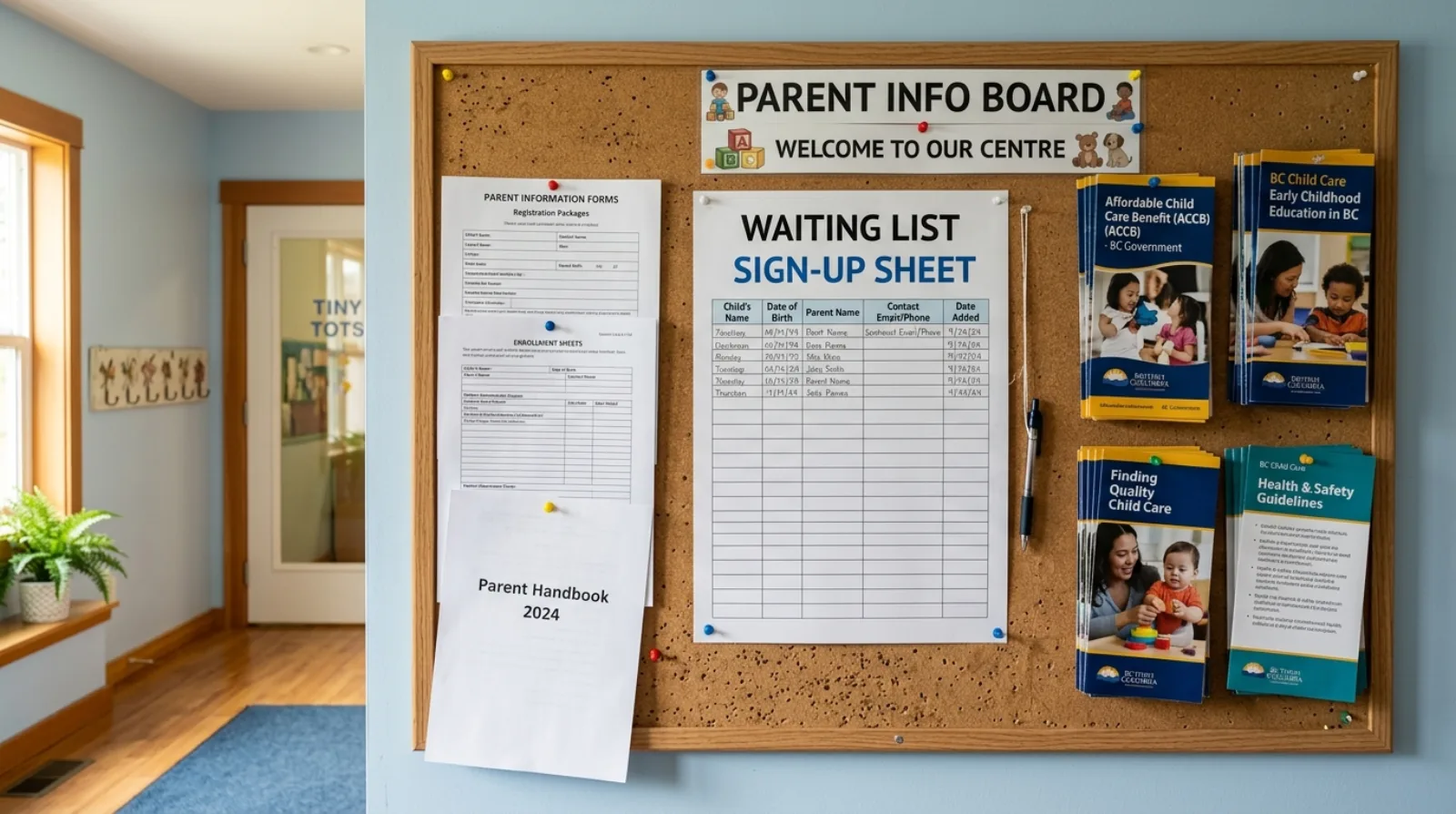
A waitlist is where most families spend their choosing. The tours are an afternoon each, the comparison is a kitchen-table hour, and the waitlist is six to twelve months of mostly nothing happening until one phone call.
The confusion about waitlists in British Columbia is almost entirely about the shape of the system. Three facts clear up most of it.
The Province does not run a central list. Each centre runs its own.
The order is rarely strict first-come first-served, because a space is almost always tied to a specific age band and often a specific schedule, and the next person on the list has to fit the opening.
A family is normally on three to five lists at once, and no centre is offended by that.
The rest of this page unpacks the mechanics.
Why there is no central list
Licensed child care in British Columbia is a mixed system of non-profits, small for-profit centres, home-based licensees and school-district programs. The Province sets the regulatory floor and funds operating costs through programs like the Child Care Fee Reduction Initiative, but each centre is a separate operator with its own capacity, its own schedule, and its own enrolment process.
The Province's Child Care Map at childcaremap.ca shows every licensed facility with its address, care types and current ChildCareBC funding status. It does not list openings. Fraser Health's own licensed-facility list for the Tri-Cities does the same thing: facility names, licence types, capacity, inspection history. Neither tells you whether a space is open on any given morning.
A family who wants a spot has to contact centres directly. There is no page to monitor and no number to call for a provincial queue, because the queue does not exist as a single thing.
How a centre's list actually orders itself
Think about a centre with a Group Child Care licence for 30 months to school age. The licence specifies a maximum of twenty-five children in that program. On any given morning the centre has, say, twenty-three enrolled, with two spaces open. One of those two is a Monday-to-Friday full-day spot left by a family moving to another city. The other is a Tuesday-Thursday spot left by a family who stopped using the second half of their schedule.
The centre now has a list with sixty-four families on it. The Monday-to- Friday spot cannot go to a family who only wants two days, because the other three days would then be unfunded and empty. The Tuesday-Thursday spot cannot go to a family who needs five days unless they can accept starting part-time and growing into a full week later. The list is a pool, not a queue; the match matters as much as the position.
Add in sibling priority at some centres, staff-child priority at others, and whether a specific child's age bumps them into a different licensed program if they turn thirty-six months in the interim, and the "order" of a list stops looking like a line.
A centre that calls you in month three when you joined in month six, with a Tuesday-Thursday spot that matches your schedule exactly, has not jumped anyone. It has matched the opening to the family it fits.
What sibling priority is, and how to find out whether it applies
Many centres give sibling priority: when a space opens, a family with an older child already enrolled is contacted first if their younger child fits the opening. This is legal and common, and sits inside the centre's own enrolment policy, which the regulation requires to be set in writing.
The practical effect for a family without a sibling at the centre is that some openings bypass the ordinary list. If sibling priority is important to you (either because you want to use it for a future second child, or because you want to understand your odds without one), ask the question directly at the enrolment conversation. A centre will say plainly whether sibling priority is automatic, used as a tiebreaker, or weighted some other way.
Deposits, holds and administrative fees
Section 14 of the Child Care Licensing Regulation requires the licensee to give every parent a written statement of the fees charged and the services they cover. The exact figures vary by centre and are not regulated. What is regulated is the paperwork: a parent must receive a written statement before care begins, and the licensee has to hold a record of it.
Three terms matter.
A waitlist fee is paid at the time a family joins the list. Not every centre charges one. Where a fee is charged, it is usually small, and the regulation requires it to be disclosed in writing in advance.
A registration fee is paid when a specific space has been offered and accepted, usually one-time. Again, if charged, it has to be disclosed.
A deposit holds the specific accepted space off the market until the start date. Deposits are normally applied against the first month's fees. The Province's Child Care Fee Reduction Initiative covers monthly fees at participating centres and does not cover deposits, registration or waitlist fees, so these come out of the family's pocket in full.
The published Fee Reduction Initiative pages make this explicit. Centres that participate in the Initiative pass the monthly reduction through on the parent's invoice, with the amount shown as a line item. Any administrative fee or deposit sits above that line.
The phone call, and what to do with it
When a space matches, the centre contacts the family, usually by phone with an email follow-up. The window to respond is short. Two to five business days is typical, because the next family on the list is also waiting and the centre cannot leave the space open indefinitely.
Before the call comes, write down three things.
Your minimum acceptable start date, and the maximum you will delay the decision for. If a centre's offer is for three weeks earlier than you expected, is that workable or not?
Your minimum acceptable schedule, and whether starting part-time and growing into full-time is an option. Many offers that look like a bad fit at first can be accepted on a conditional schedule and adjusted.
The two or three other centres you are also waiting on, and roughly where you stand with each. If you decline this offer, how likely is a better one in the next month?
The best decision at the moment of the call is the one you have thought about before the call comes.
Being on multiple lists is not rude
Centres know families are on several lists. The arithmetic requires it. A centre that only enrols families who are on no other list would run empty.
What is appreciated is honesty about where you stand. If you are top three on another list and your preference is for the other centre, telling the centre that is useful information for both sides. If you are planning to decline a space to wait for another, saying so promptly is kinder than disappearing.
The reverse is also true. If a centre tells you honestly that an offer is three to six months away, that is useful, and far better than vague reassurance that lets you make plans around an unlikely date.
When the list changes shape
A family's needs change during the wait. A move, a job change, a sibling, a decision to extend parental leave, a different preferred language program. Tell each centre as the change happens. The regulation requires the licensee to hold a current record of each child's circumstances once care begins, but before that, your file is as current as what you tell them. A centre offering you a Monday-Wednesday-Friday spot you no longer want is wasting your time and theirs.
How long the wait actually runs
The honest answer varies by age band and by neighbourhood. Infant and toddler spaces in the Tri-Cities are the scarce ones, because the regulation caps infant-and-toddler educators at four children apiece, and most centres run one or two groups rather than more. For a child under three, a wait of twelve to eighteen months is not unusual, and families who need a specific start date often start the search before birth.
Spaces for children over thirty months move more quickly. A Group Child Care program for thirty months to school age can hold up to twenty-five children in a group, and some turnover from kindergarten exits each September creates predictable openings. A six-to-nine-month wait is common; a three-month wait at a popular centre is possible if the schedule matches.
Preschool programs, which run shorter part-day sessions, usually enrol once a year in September with a smaller flow of mid-year openings when families move or switch to full-day care.
The Province's advice is simply to start as soon as you can, which is less of a slogan than it looks: the scarcity is structural, not seasonal.
The next piece
Once a space is offered, the choice becomes a real one. The next piece, matching a daycare's program to your child, covers what to pay attention to when the specific offer is in front of you.
Questions parents ask
Frequently asked questions
Choosing a daycare