Part 1 of 6
What to notice on a daycare tour, without being told
A tour is more useful when you know what to look at. Watch the lead educator for a few unbroken minutes, pay attention to the quiet pockets of a classroom in use, measure the space honestly against the regulation, and read the washroom carefully. The six cues that run below the surface of a tour.
By Tracy, Owner and Principal
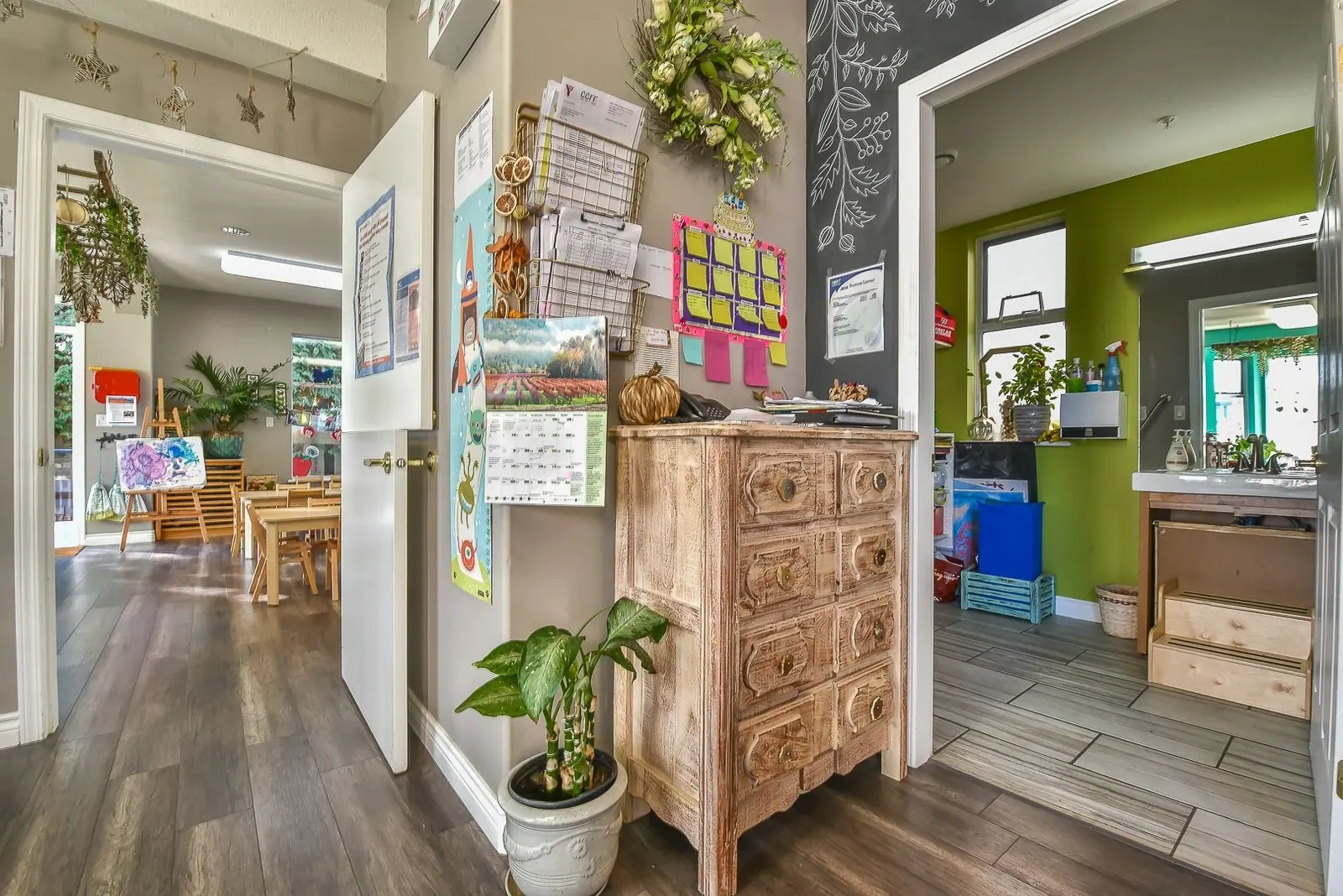
A tour is a thirty-minute window. The centre uses it to describe the program. Most families use it to form a feeling. Both are useful. Neither is enough.
What follows is what to watch for underneath the walk-through, in rough order of importance. The order is deliberate: the lead educator matters more than the building, which matters more than the branding, which matters almost not at all.
The lead educator, for a few unbroken minutes
Buildings and curricula rarely differ as much as parents expect. The educator who will spend eight hours a day with your child differs enormously from centre to centre, and the way to see this is to watch her, in her own room, for several unbroken minutes while someone else gives you the tour.
What you are looking for is specific attention. An educator who notices which child is at the water tray and names what they are doing. An educator who intervenes early when a conflict is building, instead of after it has started. An educator who moves between children at different corners of the room without losing track of the whole.
This is harder to fake than any program feature. A rehearsed sentence about emergent curriculum takes a sentence; two or three minutes of watching reveals whether the person speaking it does the thing.
Ask whether you can stay in the room for a few minutes while the person giving the tour steps aside. A centre comfortable with you watching the room is a centre with nothing to hide.
The sound of the room
A working classroom is quiet in a particular way. The sound comes from children absorbed in work rather than from one adult directing the whole group. Pockets of focused activity are a strong sign; one loud shared one is a weaker sign.
Perfect silence is not the goal. Play has a sound to it. Children who are building, pretending or arguing a point out loud are doing exactly what they should be doing.
What is worth attending to is the balance. If a single adult voice is driving the sound of the room, the room may be well-managed and may equally be under-populated with activity. If the children are all doing the same thing at the same time, that is a transitional moment, not teaching.
The space, measured against the regulation
The Child Care Licensing Regulation sets a minimum of 3.7 square metres of indoor activity space per child, and at least 7 square metres of outdoor play space per child. These are floors, not targets, and a centre at the floor is not deficient. A centre with more has more slack.
You do not need to measure. The posted licence names each care program and its maximum number of children. If the room looks tight for the number of children on the licence, note it. If it feels generous, note that too.
The outdoor space is where the figures become visible. A yard with 7 square metres per child for a group of fifteen is 105 square metres, roughly a 10-by-10 room's worth of open space. A yard that feels like a corridor between fences is worth asking about.
The washroom and the diapering area
These rooms are the hardest to make look good superficially, which is why they are useful on a tour. Schedule D of the regulation requires the diapering surface to be non-porous, at adult working height, with a handwashing station beside it, in a location sanitary and separate from food preparation and children's play.
A worn pad, no handwashing station visible, or diapering happening on the floor is a sign the ordinary routine is not what the paperwork describes.
In the children's washroom, look at the sinks and the soap dispensers. An empty dispenser on an ordinary morning is a small thing worth noting, not because the centre is unsanitary but because it is the kind of detail that tells you how closely the day is run.
Sight lines and the arrangement of the room
Children's furniture is low because supervision is impossible if sight lines are not. From any point in the room, a staff member should be able to see any other point. Blind corners, high dividers, and curtained-off areas require more staff and more active movement to monitor safely, which a centre may do well or may do less well.
The ordinary pattern is low open shelves for materials children may use freely, taller shelves at the back for materials that require an educator's hand, and clear zones for different kinds of activity (reading, art, blocks, sensory play, dramatic play). A single multipurpose carpet in the middle of a bare room is not necessarily wrong but is a weaker arrangement than one that lets several kinds of activity happen in parallel.
The outdoor space and the gate
The regulation requires the outdoor play area to be fenced and separated from any area used by vehicles. The 7 square metres per child applies here. Look at how the gate works: whether it latches to a height a toddler cannot reach, whether it is in sight of the main indoor space, whether the surface underneath drains or pools in rain.
A gate that latches high is a specific detail an officer will look at. A gate on the honour system is one worth asking about.
Posted licence and inspection history
Section 11 of the regulation requires the licence and the certificates held at the facility to be posted. Read it. The licence names each program the centre may run and the maximum number of children allowed on the premises at one time, and should match what the person giving the tour described.
The published inspection reports are a separate exercise, covered in reading a daycare's inspection history. A tour is not the right moment to read them, but it is a good moment to ask whether the person giving the tour has read the most recent one. If she has, she will say so and often summarise it. If she has not, that answer is information too.
The food preparation area, if the centre provides meals
Centres fall into two groups: those that provide meals and those where families pack them. La Vie Est Belle is in the second group, so families pack labelled, nut-free meals and snacks each day. A tour at a centre that provides meals should include a brief look at the kitchen, which Schedule D of the regulation requires to be set apart from children's play and diapering areas. The surfaces, the handwashing station, and the storage visible from the doorway tell you most of what you need, without needing to inspect the pantry.
At a pack-your-own centre, ask instead where lunches are stored during the morning, whether anything requires refrigeration, and how educators handle a child who has forgotten a lunch. The specific answer tells you how the centre runs on an ordinary day with an ordinary disruption.
Fire safety and emergency plans
The regulation requires every licensed facility to have written emergency procedures and to practice fire drills. On the tour, note the position of the fire exits in each room, the storage of first aid supplies, and whether the emergency plans and shift schedules are posted somewhere visible. A centre that treats the drill schedule as a public document is one that runs drills on time. A centre where the plan is in a binder nobody has opened in a year is a weaker answer, even if the binder is up to date.
Ask casually how often the drills run. The regulation requires monthly fire drills; a specific answer, with a recent example of a drill the children remember, confirms the policy is operating.
What matters less than it looks
The tidiness of the room at the end of a Monday morning. A classroom in use is a working room, and stacked mats and clean floors at pick-up are a tidy room, not a better one.
The newness of the furniture. New furniture is pleasant; older well-kept furniture is not a sign of a worse centre. Educators matter more.
The decor and the branding. Taste is personal. A room designed for its Instagram photograph may look identical in person and feel different, and the reverse is also true.
The age of the building. Converted houses, purpose-built facilities, and spaces inside community centres all appear on the Province's list of licensed centres, and the age or type of the building tells you almost nothing about the care inside it. The regulation sets the same space, hygiene and safety requirements regardless of whether the walls are new.
A note on bringing your child
If your child's age makes it practical, bring them. Educators get to see your child in the space, you get to see your child's reaction, and the tour closes with a conversation about start dates and specific needs that lands better with the child in the room. Watch the educator's attention: a good one will greet the child by name within the first few minutes and track their response as the tour moves.
The reaction you want is curiosity, not necessarily comfort. A child who walks straight to the block corner is signalling something useful. A child who clings and watches is signalling something else, and that is useful too. Neither tells you the centre is right or wrong; both tell you how your child reads the room.
Writing it down
Write the notes the same day, before touring the next centre. A week later the specifics blur, and three tours blur into one impression. A short set of bullet points per centre, written on the kitchen table that evening, is far more useful at the comparison stage than a memory of how each room felt.
What to ask on the tour, so the answers tell you something, is in the next piece. The two together, watching and asking, are what a thirty-minute visit can actually accomplish.
Questions parents ask
Frequently asked questions
Choosing a daycare