Part 2 of 5
Packing a safe, nut-free daycare lunch
A practical guide to packing lunch for a child at a BC daycare where families provide every meal. Food-safety rules from Health Canada, the choking-hazard preparation list, and the specific label-reading that keeps a nut-free centre nut free.
By Tracy, Owner and Principal
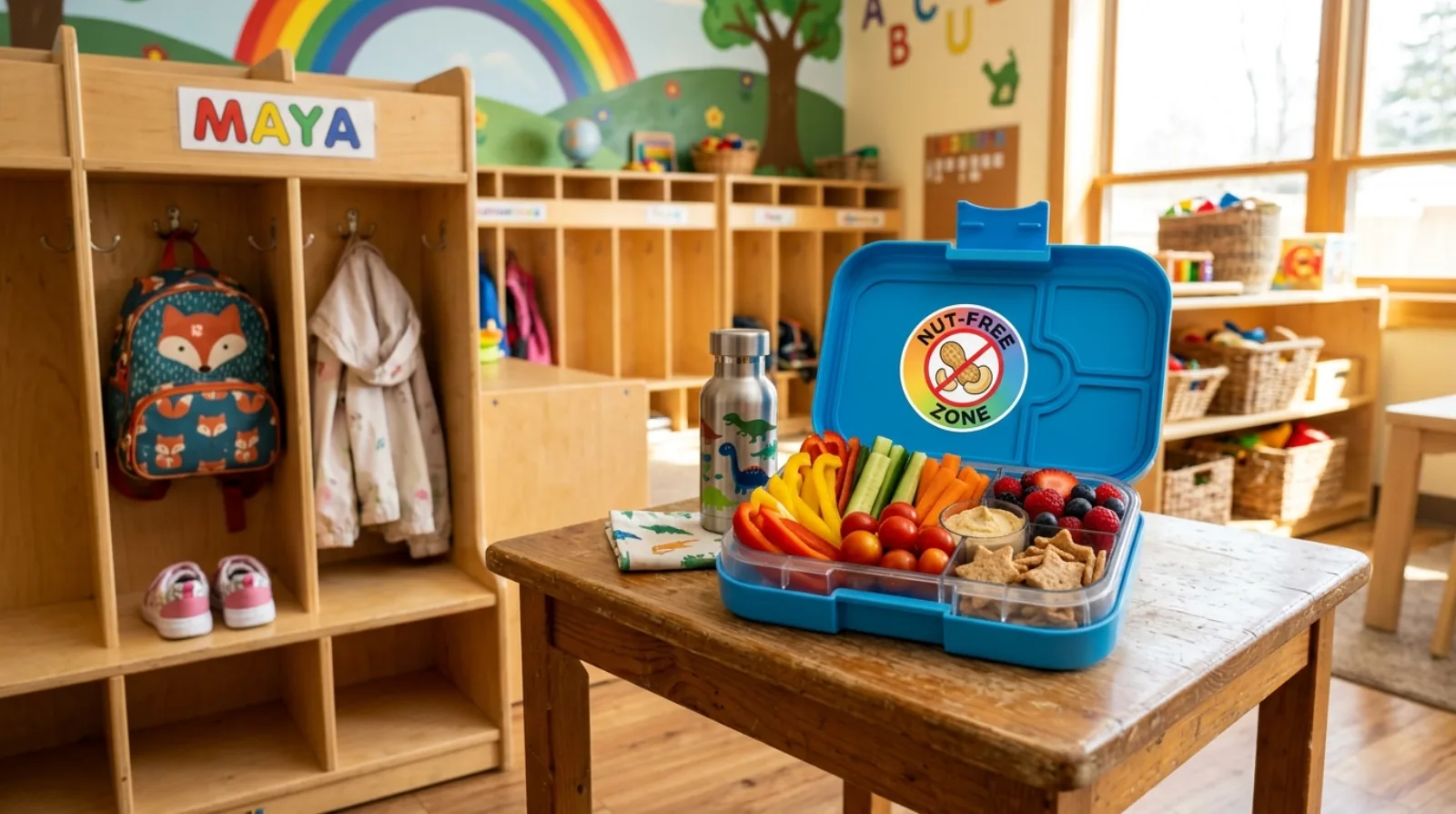
Packing lunch for a daycare where families provide every meal is a small daily job that becomes a routine within a week. The parts worth getting right at the start are the temperature-safety side, the choking-hazard preparation side, and the label-reading side, because those are the three places where a well-meaning packed lunch quietly fails.
The frame: Canada's Food Guide plate
Build each lunch to the plate. Half vegetables and fruits, a quarter whole-grain foods, and a quarter protein foods, with water alongside. For a two or three year old that often looks like:
- Six to eight small pieces of cucumber or pepper (one quarter of a sweet pepper, say).
- Three strawberries, or a quarter apple cut into thin wedges, or half a banana sliced into coins.
- A quarter-sandwich on whole-wheat bread, or three or four whole-wheat crackers, or a few spoonfuls of brown rice.
- A protein: a scrambled egg from this morning, a small container of yogurt, a thin slice of cheese, a few beans from last night's chili, a tablespoon of hummus, or a few cubes of cooked chicken.
- A labelled water bottle.
The plate does not have to be perfect every single day. It has to look roughly like the picture over the course of a week.
The temperature rule, which is the one that catches people
Health Canada's safe-school-lunches guidance is clear: keep cold food cold and hot food hot. The danger zone where bacteria multiply is 4°C to 60°C, and food left in that range for a cumulative two hours is no longer safe. "Cumulative" matters, because an hour on the counter cooling after dinner, an hour in a warm lunch bag on the way to the centre, and three hours before lunch adds up to five hours in the danger zone from the perspective of the sandwich.
Four practical rules follow from this.
Use an insulated lunch bag. Any insulated bag reduces heat transfer, and the ones with built-in gel panels add a few degrees of margin.
Pack an ice pack. A single ice pack keeps a packed lunch under 4°C for roughly four hours in a decent insulated bag. Two is better for a hot summer day.
Freeze a backup. Freeze a water bottle, a yogurt tube or a sealed piece of fruit the night before. It defrosts by noon and the child eats or drinks it, so no leftover packaging to carry home.
For a hot item, use a thermos. Heat the thermos with boiling water for a minute before filling, then fill with food reheated to 74°C or above. A thermos filled with lukewarm leftovers from the fridge is a bacterial incubator, not a lunch.
Wash the bag with hot soapy water each evening. Do not reuse disposable plastic wrap or sandwich bags; they tear and reseal poorly and carry a day's worth of handling.
The choking-hazard list, with the preparation that fixes it
Health Canada's safe-food-handling guidance for children ages five and under lists specific foods as high choking risks, and for several it adds a preparation that makes them safe. The list, with the preparation:
- Whole grapes: halve or quarter.
- Hot dogs and sausages: cut lengthwise, then dice. A round slice is the shape most strongly associated with fatal choking.
- Raw carrots: grate for toddlers; very thin matchsticks are the next option.
- Firm raw fruit (apple, pear): very thin slices or grated.
- Celery, pineapple, mango, pineapple core: finely chop; strip the fibrous strings from celery.
- Peanut butter (where permitted): thin spread on bread or crackers, not a scoop.
- Cherries, olives: pit, then halve.
- Dried fruit (raisins, dried cranberries, dried apricots): chop for younger toddlers; whole raisins can lodge.
Foods not safe for children under four at all, regardless of preparation: hard candies, cough drops, gum, popcorn, marshmallows, whole peanuts or other nuts, seeds (sunflower, pumpkin, chia if dry), and fish with bones. These should not be in a daycare lunch for a child in the early years, period.
The nut-free list, which is longer than it looks
La Vie Est Belle is a nut-free facility. Every family keeps the rule for the benefit of children with allergies in the room. The obvious items are easy: no peanut butter, no almonds, no cashews, no walnuts, no pecans, no pistachios, no hazelnut spread, no trail mix.
The less obvious items are where the policy fails. These are the categories to read labels on:
- Granola bars and cereal bars. Many brands have peanut, almond or "may contain" warnings even in flavors that do not advertise nuts.
- Cereals. Granola, muesli, chocolate cereals and even some corn flakes carry warnings.
- Chocolate. A plain chocolate bar often shares equipment with nut varieties. The "may contain nuts" line is on the back.
- Baked goods from a bakery. A commercial bakery that handles almonds is a shared-surface risk even for a plain muffin.
- Dried fruit mixes. Trail mix, obviously; also fruit-and-nut mixes sold as "healthy snacks".
- Pesto. Traditional pesto contains pine nuts; many jarred versions use cashews.
- Thai, Vietnamese, Indonesian and some West African prepared foods. Peanut sauces and crushed peanut garnishes are common.
- Protein bars and energy bars for adults. Many contain almond flour or peanut flour.
- "May contain" statements. Canada's food-labelling rules require declared allergens on the ingredient panel. The voluntary "may contain" statements flag shared equipment. Both are reasons to keep an item at home.
A quick rule of thumb: if the packaging is unclear, leave it out. The nut-free rule works on prevention, not on close calls.
Honey, raw foods and the under-one list
For an infant under one year old, honey in any form is not safe. This includes honey as a sandwich filling, in a smoothie, as a drizzle on toast, in granola, in hot drinks, or in medicines marketed for coughs. The reason is infant botulism, which is caused by Clostridium botulinum spores in honey that can colonize an infant's intestinal tract.
Other items Health Canada names for the under-five list that stay out of a lunch bag:
- Raw or unpasteurized milk.
- Raw or lightly cooked eggs, including anything containing them (homemade mayonnaise, hollandaise, raw cookie dough, mousse made without pasteurized egg).
- Raw or undercooked meat or poultry.
- Raw sprouts (alfalfa, clover, radish, mung beans).
- Raw oysters, clams, mussels, or sushi.
- Unpasteurized fruit juice and cider.
Cooked versions of most of these are fine. The avoid list is about rawness and pasteurization, not about the food itself.
A week of lunches
To make the plate concrete, here is a week of packed lunches for a two-and-a-half year old at a nut-free centre:
- Monday: quarter whole-wheat tortilla with hummus, roasted red pepper and cucumber coins; strawberries; a cube of cheese; water.
- Tuesday: small portion of yesterday's cold whole-wheat pasta with cherry tomatoes (quartered), olive oil and shredded chicken; thin apple wedges; plain yogurt; water.
- Wednesday: small whole-wheat pita, cut open, with scrambled egg and a thin layer of grated cheese; grated carrot with a dash of lemon juice; a few orange segments cut in half; water.
- Thursday: half a thin whole-wheat bagel with cream cheese; shredded chicken with chopped cucumber; grapes cut in quarters; water.
- Friday: sushi-shape rolled wrap with turkey, lettuce and avocado; a few steamed broccoli florets; raspberries; a tiny homemade muffin (nut free); water.
Portions are small. The point is a plate the child finishes, not a plate they look at and give up on.
Labels on the box: the family's job
Section 48(6) requires the centre to tell parents about food served at the centre. In a bring-your-own centre, the mirror of that is the family labelling what they packed. Three labels help:
- The child's name, on the lunch bag and every container. This is the one that keeps a lunch with its owner at a shared table.
- The date, on anything cooked more than a day ago. A yogurt that expired last week is a yogurt that can go home.
- Any allergen flag, on food for a child with a severe allergy, so an educator who glances at a container does not have to open an ingredient conversation at lunch.
Labels on tape are fine; permanent-marker labels on silicone or bento sections are better over time. Either way, the point is the same: a lunch with a name on it is a lunch an educator can trust.
Allergies and anaphylaxis at daycare covers the paperwork side if the child has a severe allergy, and snacks, water and the rhythm of the day covers the mid-morning and mid-afternoon snacks that sit on either side of lunch.
Questions parents ask
Frequently asked questions
Food and meals at daycare