Part 1 of 5
What a daycare in British Columbia can and cannot serve
A full walk through section 48 of British Columbia's Child Care Licensing Regulation, the Canada's Food Guide guidance behind it, and Health Canada's safe-food-handling list for children under five. What a BC daycare must do, must not do, and may do.
By Tracy, Owner and Principal
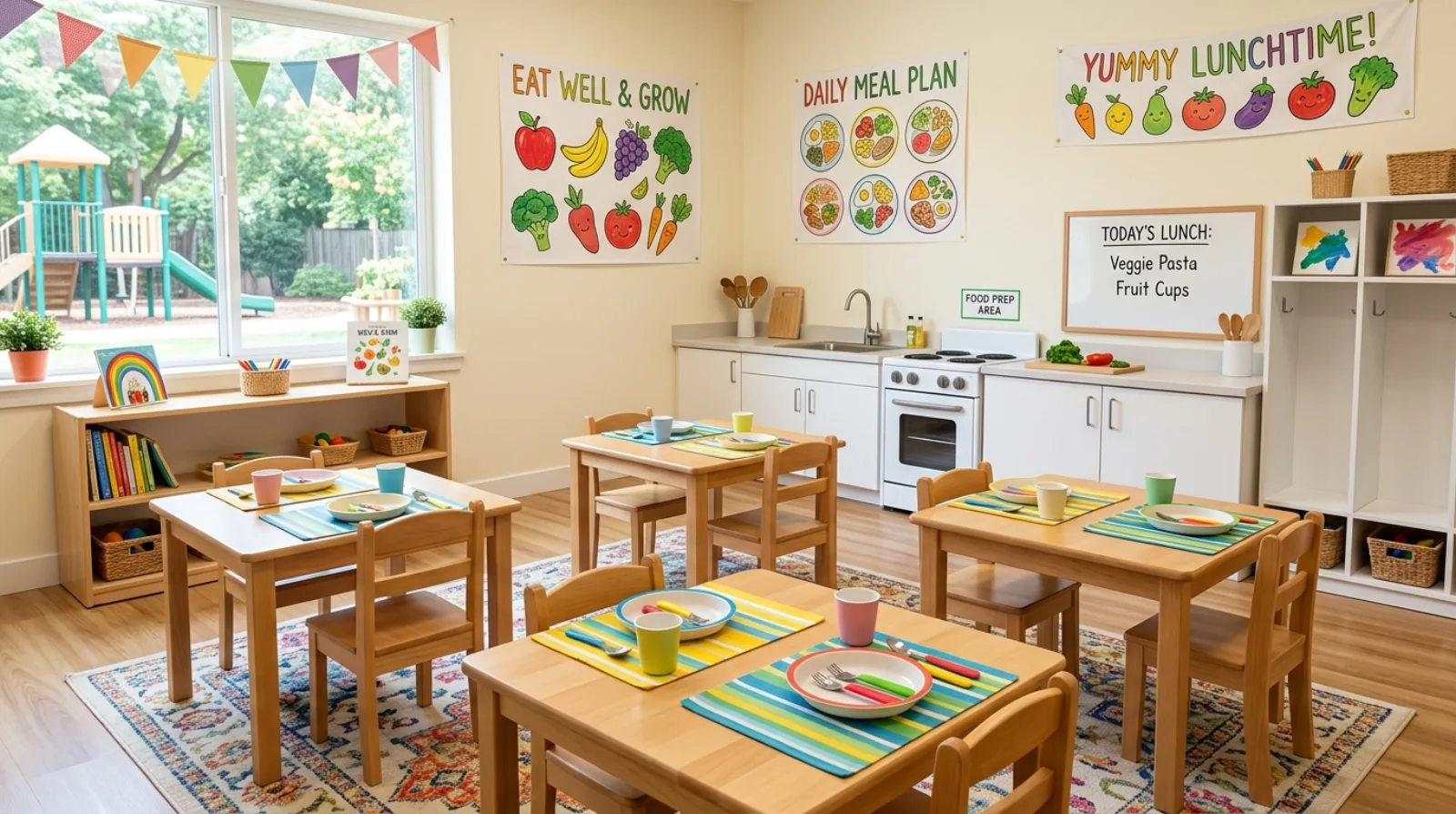
Twelve lines of regulation sit behind every meal and snack in a licensed BC daycare. It is a short section and worth reading before anything else. What follows is section 48 of the Child Care Licensing Regulation, line by line, with the Health Canada guidance each line points at.
Section 48(1), the Food Guide rule
A licensee must ensure that each child has healthy food and drink according to Canada's Food Guide, and must promote healthy eating and nutritional habits.
That is the whole first subsection. "Healthy food and drink according to Canada's Food Guide" is the entire standard the centre has to meet, and "promote healthy eating and nutritional habits" is a wider obligation about how food is served and discussed in the room.
Canada's Food Guide is published by Health Canada and lives at food-guide.canada.ca. The current guide, released in 2019 and still current in 2026, shifted away from the older four-food-group model to a plate-proportion model. The visual snapshot shows half the plate covered by vegetables and fruits, a quarter by whole grain foods, and a quarter by protein foods, with water as the drink of choice. There is no explicit serving size for a four year old; the guide works by proportion rather than quantity.
For a daycare, this changes two things in practice. A packed or served lunch does not need to tick exact boxes; it needs to look like the plate. And "whole grain" is doing work: a white-bread sandwich with cheese and apple is not what the guide shows. Whole wheat, oat, barley, brown rice and the whole-grain versions of pasta, crackers and tortillas are what the guide names.
Section 48(2), when the Food Guide bends
Section 48(2) says that if a child's record includes, or the child has a care plan that includes, instructions respecting food and drink for the child, the Food Guide requirement does not apply to the extent it is inconsistent with those instructions, and the licensee must comply with those instructions.
That is the clause that lets a centre feed a child with a disclosed allergy, intolerance, religious practice, cultural need or medical condition without breaking the regulation. The clause is narrow and documented. "The child does not eat broccoli at home" is not an instruction under section 48(2). "The child has a confirmed peanut allergy and the attached anaphylaxis action plan" is.
The record under section 57 and the care plan under section 58 are the places where food and drink instructions live. Both have to be in writing, and the care plan has to be reviewed annually in consultation with the family.
Section 48(3), quantity and quality for the age
A licensee must ensure that the food and drink given to a child is sufficient in quantity and quality to meet the developmental needs of the child, having regard to the child's age, the number of hours the child is under the care of the licensee, and the child's food preferences and cultural background.
Age and hours matter here. A toddler at the centre from 7:30 am to 5:30 pm needs breakfast or an early snack, a morning snack, lunch, an afternoon snack and sometimes a second afternoon snack. A preschooler there from 9 am to 3 pm needs a morning snack and a lunch. In a centre where families provide every meal and snack, this subsection translates to a packing list that scales with the hours the child is there.
"Food preferences and cultural background" is a real requirement, not a courtesy phrase. A child whose family eats vegetarian, halal, kosher, Hindu-vegetarian, lactose-free or gluten-free food is entitled to food that fits. In a centre that cooks, that means a kitchen that can prepare more than one lunch. In a centre where families pack, it means the policy supports what the family packs rather than overriding it.
Section 48(4), the three prohibitions
Three specific practices are forbidden. A licensee must ensure that children are not fed by means of a propped bottle, forced to consume any food or drink, or left unsupervised while consuming food or drink.
The propped bottle rule is specific to infants. Propping a bottle against a child's mouth so the child feeds without a caregiver holding it is forbidden, because the child cannot stop the flow, cannot clear their airway without help, and is at a higher risk of ear infections and tooth decay. In practice, a licensed centre that takes infants carries this rule as a hard operational rule.
The no-forcing rule is where a lot of family history collides with the law. A caregiver who grew up being told to clean the plate often has to be reminded that the regulation forbids them from applying the same practice. "Finish your lunch and you can play" is on the wrong side of the line. Offer, invite, sit, model: those are permitted. Force is not.
The no-unsupervised-eating rule means a child does not sit alone with food. Choking is the stated reason, and the rule covers a child wandering off to a quiet corner with a snack as well as a child left at a table while the educator steps out. The rule is one of the quieter reasons a centre is staffed to its licensing ratios through the full meal period.
Section 48(5), safe drinking water
Safe drinking water must be available. That is the whole subsection, and it is binding. "Available" means a child who is thirsty can get water with help, not that water is theoretically present in the building.
In a centre that uses labelled reusable bottles, availability means the bottles are within reach, refilled through the day, and offered rather than waited for. In a centre with open cups at the table, it means the pitcher is on the table at meals. The regulation does not prescribe the method, but it does require the outcome.
Section 48(6), information for parents
A licensee must make available to parents information on the food and drink given to children. At a centre that cooks, this is a published weekly menu. At a centre where families pack, the obligation applies to any food the centre serves on top of what families bring, for example a birthday snack from another family, or a seasonal treat during a holiday celebration. The rule exists because an allergy, intolerance or religious practice is only safeguarded if the family knows what their child was offered.
Section 48(7), no food as reward or punishment
A licensee must ensure that food and drink are not used as a form of reward or punishment for children. This is the subsection most new educators have to adjust to. "You can have your dessert when you finish your sandwich", "no snack because you did not clean up", "whoever is quiet gets a cookie", and the opposite "you have to sit at the table until you have eaten" are all prohibited. The rule covers withholding food for behavior and offering food contingently on behavior.
A birthday cupcake is not a reward in this sense; it is a celebration shared with the group. A sticker chart that pays out in food is a reward in this sense and is not permitted.
What is off the plate: Health Canada's avoid list
The regulation does not list specific foods to exclude, but Health Canada's safe-food-handling fact sheet for children ages five and under names several that should not be served: raw or unpasteurized milk, raw or lightly cooked eggs or egg products containing them, raw or undercooked meat or poultry such as steak tartare, raw oysters, clams and mussels, raw sushi, raw sprouts such as alfalfa, clover, radish and mung beans, unpasteurized fruit juice and cider, and honey for children under one year old.
A separate list covers choking hazards. Hard candies, cough drops, gum, popcorn, marshmallows, whole peanuts or other nuts, seeds, and fish with bones are not safe for children under four, and should not be in a daycare lunch bag at any point in the early years. Hot dogs, sausages and grapes are permitted if cut lengthwise or chopped; raw carrots and firm fruits should be grated; fibrous foods like celery or pineapple should be finely chopped. Peanut butter, where allowed, is a thin spread rather than a scoop.
At a nut-free centre, the whole peanuts and tree nuts items are off the plate for the separate reason that another child in the room may have a peanut or tree nut allergy, not only because of the choking risk.
What the regulation does not do
Section 48 does not set calorie counts, portion sizes, meal timings or specific food lists. It does not require specific allergens to be excluded building-wide. It does not require menus to be approved by anyone, written in a particular format, or published publicly. It does not restrict a family's packed lunch beyond the sanitary-handling rule in section 56 and the general requirements in sections 48 and 57.
Where a centre has rules that go beyond the regulation, the centre's own written policy is where those rules live. A nut-free policy is one of the common ones; a sugar-free policy, a daily fruit requirement, or a packed-lunch inspection step are others. These sit on top of the regulation rather than inside it, and the centre's policy is where to look for them.
The pillar page sets the whole hub in context. Packing a safe nut-free lunch is the practical next step for families whose centre asks them to bring the food.
Questions parents ask
Frequently asked questions
Food and meals at daycare