October 6, 2026
Block play, and the early maths hiding inside it
Children who build with blocks are working on spatial reasoning, and spatial reasoning predicts later mathematics. What the research actually found, why the words an adult uses while watching matter, and what to put on the floor.
By Tracy, Owner and Principal
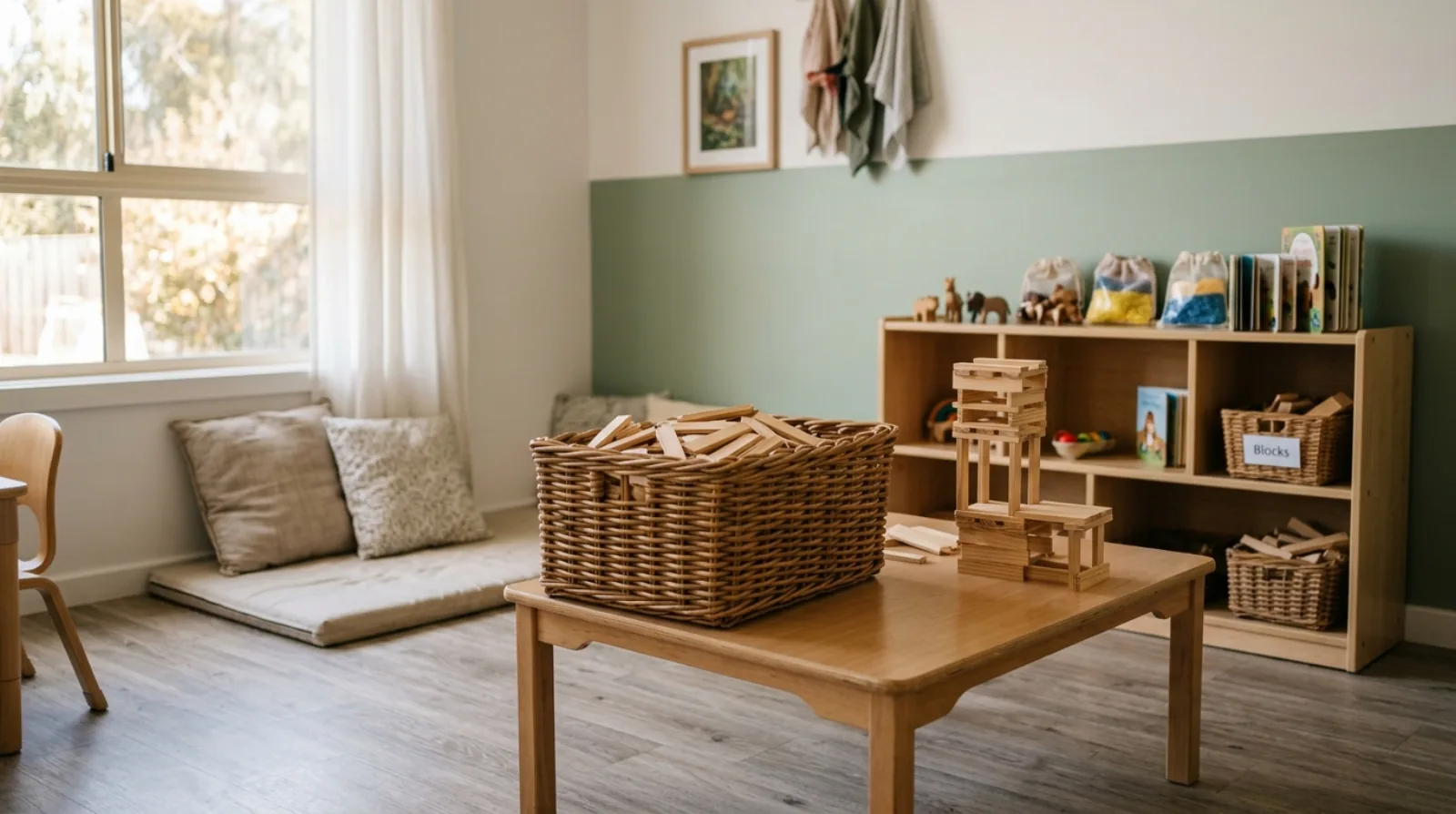
A four-year-old here spent the better part of an hour building a tower out of flat wooden planks. It fell down four times. On the fifth attempt she widened the base without anyone suggesting it.
That is an early mathematical correction, arrived at through failure, and nobody said a number out loud during the entire hour.
Block play has a reputation as the wholesome-but-vague corner of early learning, the thing you approve of without being able to say why. The research is more specific than that, and knowing what it actually found changes what a parent might usefully do while watching.
What the studies found
Two pieces of research are worth knowing about, and it is worth being precise about what each one showed.
The first, published in Child Development in 2014 by Verdine and colleagues, looked at preschoolers' performance on a spatial assembly task, essentially copying a structure from a model, and found it related to their early mathematical skills. Children who were better at putting shapes together in space were also further along mathematically.
The second is older and tracks children over time. Stannard, Wolfgang, Jones and Phelps published a longitudinal study in Early Child Development and Care in 2001 that followed children from preschool onward and found that the complexity of their construction play predicted mathematics achievement in later school years.
A related finding from Levine and colleagues, published in Developmental Psychology in 2012, is that early puzzle play predicted preschoolers' spatial transformation skill, which is the ability to mentally turn a shape and work out what it would look like.
Two cautions, because they matter. These are associations found across groups of children, not promises about one child. And an association does not by itself prove that the blocks caused the mathematics, since children who enjoy building may differ in other ways too. What the pattern does justify is taking construction play seriously rather than treating it as the filler between real activities.
Why spatial reasoning connects to mathematics
Spatial reasoning is the ability to picture shapes and space in your head and manipulate them. Turning a shape mentally to see whether it fits. Judging whether a gap is wide enough before you try. Understanding how pieces combine into a whole, and how a whole breaks into pieces.
Once you put it that way, its connection to mathematics stops being mysterious. Geometry is explicitly spatial. Measurement is spatial. Fractions are a spatial idea before they are a numerical one, because a child who can see half of something has understood something real. Even arithmetic leans on a mental number line, which is a spatial object.
A child who has spent hundreds of hours discovering that two short planks equal one long one, that a wide base holds more than a narrow one, and that a tall thing falls further has built a physical intuition that later mathematical language gets attached to.
The part that is actually about the adult
Here is the most actionable finding in this whole area, and it has nothing to do with which blocks you buy.
Spatial language is the vocabulary adults use least around young children. Over, under, beside, between, through, behind, edge, corner, straight, curved, taller, wider, deeper, half, whole, above, below. These words are not hard, and they simply do not come up much in ordinary talk with a child, which tends to be dominated by objects and actions.
Children who hear more spatial language use more of it themselves, and this shows up in their spatial skill. Block play is the ideal setting for it, because the words are genuinely useful there.
The move is to describe rather than instruct.
Instead of "good job", try "you put the long one across the top". Instead of "that's going to fall", try "that one is balanced right on the corner". Instead of "make the bottom wider", say nothing and let the tower fall, because the falling tower is the lesson and you would be stealing it.
This is harder than it sounds. The instinct to fix a wobbling tower is strong. Sitting on your hands while a child discovers the base is too narrow is the single most useful thing you can do at that moment.
What to put on the floor
Plain is better than clever.
Unit blocks and flat planks. Sets of identical flat wooden planks are exceptional for this, because the pieces are all the same and everything depends on how they are arranged. There is no intended outcome to get right.
Enough of them. This matters more than people expect. Twenty blocks produce small structures and the child moves on. Two hundred produce something a child can get lost in. Quantity changes the quality of what gets built.
Reachable without asking. A material a child has to request is a material with a tax on it. A low open basket gets used ten times more than a box on a high shelf.
One system at a time. Mixing several construction toys together usually produces less building than one system with plenty of pieces, because pieces that do not combine predictably break the problem-solving.
Sets that snap together in exactly one correct way are a different and narrower activity. Following the instructions to build the pictured model is an enjoyable thing to do and it involves much less of the working-out than an open pile of identical planks.
Time is the other ingredient
Block play has a slow start. The first minutes are usually exploratory, a child handling pieces and making small arrangements. The structures worth seeing tend to appear well after that.
Which means an hour of open access produces far more than four fifteen-minute sessions. It also means a schedule that interrupts at the twenty-minute mark reliably cuts the play off just as it gets going, which is a real cost that is easy to miss because nothing visible is lost.
Leaving a structure standing helps too. A child who can come back after lunch will often develop what is there rather than starting again, and multi-day structures are where the most ambitious building happens.
Our post on gross motor play covers the related point that whole-body movement supports the hand control all of this depends on, and our guide to what play actually builds sets out the wider picture.
Building together, and building alone
Both matter, and they do different work.
Alone, a child can pursue one idea without having to explain or defend it, and some of the most sustained concentration you will see comes out of solitary building.
Together, the demands multiply. Two children have to agree on what they are making, work out what the other one intends, divide the work, and handle it when one of them changes the plan. That negotiation is difficult and it is also where the language lives. Children building together talk considerably more than children building alone.
Children move between the two by themselves, and there is no need to push. A child who only ever builds alone at three will usually be building with others at four.
What about the knocking down
Very young children often spend more time destroying than constructing, and parents sometimes read this as a failure to engage.
It is a real experiment. What happens if I push this. Does it happen again. What if I push it there instead. Cause and effect, tested repeatedly, with a spectacular result each time. Building gradually takes over as children get older.
If demolition is genuinely the only thing happening, building something together at a low height sometimes extends the interest, because a shared structure has more pull than a solo one. A structure built to be knocked down on purpose, at an agreed moment, also satisfies the urge without ending everyone else's work.
What this looks like here
Children build with wooden planks and blocks on the floor and at the tables, alone and in groups, and structures stay standing while they are being worked on rather than being tidied away between activities.
What educators do while watching is narrate and ask rather than correct. A tower with an unstable base does not get quietly fixed by an adult hand. It falls, and the child tries again, which is the entire mechanism.
It appears in every room rather than being confined to one corner, which matters because a child who has finished with one material will often keep doing the same underlying work with another.
The short version for a parent
Get a large quantity of plain blocks or flat planks. Put them somewhere reachable. Leave long stretches of time. Describe what you see using spatial words, and resist fixing the tower.
That is most of it. A child who does this for a few hundred hours between two and five arrives at school having already met, physically, most of the ideas that early mathematics is going to name.
Frequently asked questions
Does block play really connect to mathematics?
The evidence is reasonably specific. A 2014 study in Child Development by Verdine and colleagues found that preschoolers' spatial assembly performance related to their early mathematical skills. A longitudinal study by Stannard, Wolfgang, Jones and Phelps, published in Early Child Development and Care in 2001, found that the complexity of children's construction play in preschool predicted mathematics achievement in later school years. These are associations found in groups of children rather than a guarantee about any individual child.
What is spatial reasoning, in plain terms?
The ability to picture shapes and space in your head and work with them. Mentally turning a shape to see whether it fits, judging whether a gap is wide enough, understanding how parts combine into a whole, and reading a diagram or a map. It sits underneath a good deal of mathematics that appears to be about numbers, including geometry, measurement, fractions and later algebra.
What kind of blocks are best?
Plain unit blocks and flat wooden planks do more than sets with a single intended outcome. What matters is that there are enough of them to build something substantial, that they are all the same system so pieces combine predictably, and that a child can reach them without asking. Sets that snap together in only one correct way give a child less to work out.
How can I help without taking over?
Describe rather than instruct, and use spatial words. Over, under, beside, between, edge, corner, curved, straight, taller, wider, half, behind, through. Saying "you put the long one across the top" gives a child language attached to something they just did. Telling them the tower would work better with a wider base removes the problem they were about to solve.
My child knocks the tower down instead of building. Is that still useful?
Yes. Knocking down is a genuine experiment about cause and effect, and it is extremely satisfying. Younger children often spend more time on the demolition than the construction, and building gradually takes over. If it becomes the only activity, try building something together at a low height and see whether a shared structure holds their interest longer.
How much time do children need for this?
More than most schedules allow. The first few minutes of block play are usually exploratory and the interesting structures appear later, so an hour of open access produces far more than four fifteen-minute sessions. A structure a child can leave standing and return to after lunch will often be developed further rather than rebuilt.
Does building alone count, or do children need to build together?
Both are valuable and they do different things. Solitary building lets a child pursue one idea without negotiation. Building together adds planning, shared goals, and working out what the other person intends, which is harder and also where a lot of the language happens. Children move between the two on their own.
Is there a link between block play and later reading?
The clearer and better-replicated link is with mathematics and spatial skill. Block play supports language as well, because describing what you are building and negotiating a shared structure both require it. Treat any strong claim about blocks producing readers with caution, because that is not what these particular studies measured.
What about screens and building apps?
A physical block has weight, friction and a real centre of gravity, and a tower that is unbalanced falls over. That feedback is the thing a child is learning from. Digital building tools remove it. The Canadian Paediatric Society recommends limiting routine screen use for children aged two to five to about an hour or less a day, so the question is usually what the screen would be replacing.
What does block building look like at the centre?
Children build with wooden planks and blocks on the floor and at tables, alone and in groups, and structures stay up while they are being worked on. Educators narrate what they see and ask about it rather than correcting the engineering. It shows up in every room, which matters because a child who loses interest in one material often stays with another that does the same work.
Before you visit
Come and see what is on the floor. Tours run about thirty minutes by appointment and you are welcome to bring your child. Contact us to arrange one, or read more about our programs first.
Copies a ready-written post, then opens LinkedIn.