October 5, 2026
Pretend play, and the serious work happening inside it
A child running a shop with felt vegetables is practising negotiation, memory, planning and self-control. What pretend play builds, when it appears, and why the least structured corner of the room often does the most.
By Tracy, Owner and Principal
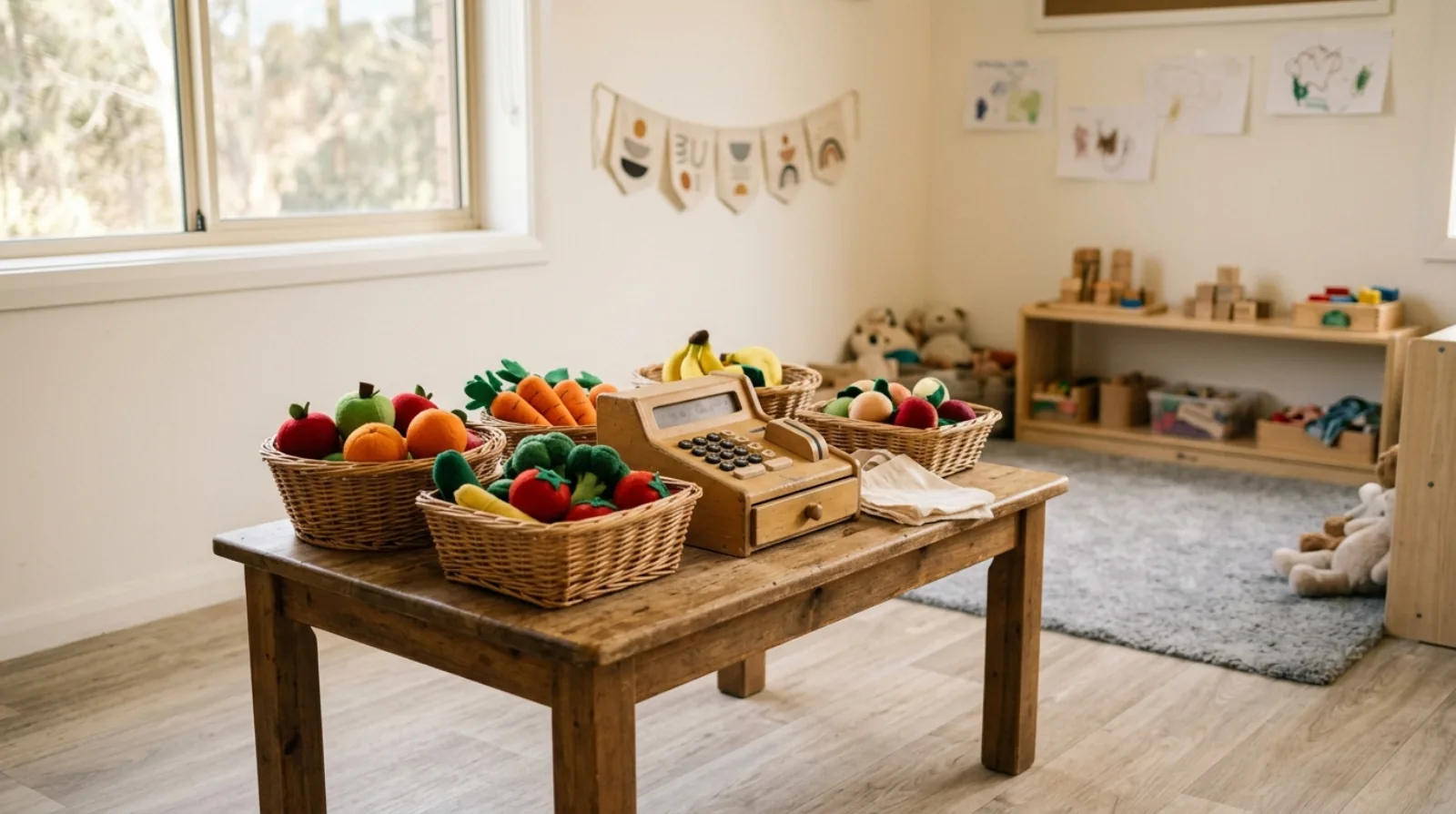
A parent stood beside me last autumn watching her three-year-old run a grocery shop out of a wicker basket and a pile of felt carrots. The game had been going for twenty minutes. Another child was the customer, and there had been a long negotiation about whether you could buy something with a leaf.
She asked me, kindly and without any edge to it, whether her daughter was learning anything or whether this was just play.
It is the most reasonable question a parent can ask, and the answer is that the twenty minutes she had just watched contained more cognitive work than any activity I could have set up for that child on purpose.
What is actually happening in the shop
Break the scene apart and the components are unexpectedly demanding.
Holding a role. The child has decided she is a shopkeeper. She is not a shopkeeper. She has to keep both facts in mind at once for twenty minutes, act consistently with the invented one, and not lose track of the real one. That is a substantial memory load for a three-year-old.
Remembering the rules. The pair of them agreed something at the start, probably in about four seconds, about what the basket is and what counts as money. Neither wrote it down. Both are expected to honour it.
Negotiating changes. When the second child decides she also wants to be the shopkeeper, the game either collapses or gets renegotiated. Renegotiating means understanding that the other child wants something different, proposing an alternative, and accepting a compromise. Very few three-year-olds do it smoothly, and all of them are practising.
Restraining an impulse. This is the one most easily missed. A shopkeeper waits. A shopkeeper does not grab the carrot back, even though she wants it, because shopkeepers do not do that. The role itself asks a child to stop doing what they feel like doing, repeatedly, for no reward except that the game continues.
That last one is worth sitting with. Asking a three-year-old to sit still for twenty minutes produces a struggle. Ask a three-year-old to be a shopkeeper and they will restrain themselves for twenty minutes without noticing they are doing it.
The research word for this is executive function
Executive function is the collective term for three related capacities: working memory, flexible thinking, and self-control. It is the machinery a child uses to hold a plan in mind, adjust when the situation changes, and stop themselves doing the first thing that occurs to them.
The American Academy of Pediatrics published a clinical report on play in 2018, in the journal Pediatrics, which describes play as building exactly this executive functioning, and identifies pretend play in particular as supporting language, symbolic thinking and self-regulation.
What makes pretend play unusual is that it is one of very few settings where a young child exercises self-control voluntarily and at length. Most situations that demand self-control from a three-year-old are imposed by an adult and resented accordingly. This one is self-imposed, because the child wants the game to keep going, and the game has rules.
You cannot sit a three-year-old down and teach executive function. It grows through use, and this is one of the main places it gets used.
When pretend play appears, and how it grows
Simple substitution usually shows up somewhere in the second year. A child holds a block to their ear and says hello. They feed a doll from an empty spoon. The gap between the object and the meaning has opened, which is the same mental move that later lets a written word stand for a thing.
Through the third and fourth years it gets more elaborate. Children start assigning roles to each other rather than just playing beside each other. They negotiate the scenario before starting, which is a real developmental step: "you be the baby and I'll be the mum" is a plan agreed in advance and then executed. Scenarios stretch longer, sometimes across days, and children begin to object when someone acts out of role.
There is wide normal variation in when each of these arrives, and the sequence is more informative than the age.
Why open-ended materials do more
Here is a finding that surprises people setting up a playroom at home: the more realistic and specific a toy is, the less it usually gets used in pretend play.
A plastic toy phone can be a phone. A wooden block can be a phone, a car, a sandwich, a baby, a wall or a piece of cake, depending on what the story needs in that moment. The block requires the child to do the imagining, which is the part that builds.
This is why the most productive pretend-play materials tend to be the least impressive-looking. Fabric. Boxes. Baskets. Plain blocks. Pinecones and stones. A set of felt vegetables is realistic enough to suggest a shop and vague enough to become something else by lunchtime.
Realistic props are genuinely useful for younger children who need a clearer prompt to get started. The balance shifts toward open-ended material as children get older and can carry more of the pretending themselves.
Our post on what your child actually learns at daycare covers the wider picture of how this kind of play maps onto the provincial framework, and our guide to early learning and play goes into what play builds in more detail.
Where the language comes from
Pretend play drags in vocabulary that ordinary conversation never reaches.
A child playing shop uses customer, price, bag, change, open and closed. A child playing vet uses patient, injection, bandage, better. These are not words that come up over breakfast, and the child needs them because the role demands them.
Children also produce longer and more complicated sentences in role than they do in ordinary talk. Something about being someone else licenses a stretch. A child who normally speaks in five-word bursts will deliver a whole speech as a shopkeeper.
And pretend play is where children attempt the hardest language a young child has to manage: negotiation. Persuading another person to do something they do not want to do, while keeping them in the game, is difficult for adults. Watching four-year-olds attempt it is watching a genuinely hard skill under construction.
At this centre the language programmes run separately, with French, Mandarin and English each taught as its own programme rather than mixed together in one group. The pretend play in a room happens in that room's language, which means the vocabulary gets used in a situation where a child actually needs it rather than being recited from a list.
What the framework says about it
The British Columbia Early Learning Framework, the Province's guidance for early years practice in its revised 2019 edition, organises its thinking around four living inquiries. One is communication and literacies, and its pathways include multiple modes of communication, culture, family, traditions and knowledge, vocabulary, symbols and written language, and sound and word play.
Pretend play touches nearly all of that at once, which is why a programme built on the framework gives it space and time rather than fitting it in around the edges.
It is worth being precise about what the framework is. It is provincial guidance about pedagogy, with no legal force. What is legally binding on a licensed centre in BC is the Child Care Licensing Regulation and the five program standards in its Schedule G. Our guide to the Early Learning Framework sets out the difference in full.
What to do with this at home
The useful moves are mostly subtractive.
Leave time. Elaborate pretend play takes a long runway. A child who has fifteen minutes before the next thing will do something else. The good stuff tends to appear somewhere after the twenty-minute mark, which is exactly the point most schedules interrupt.
Follow, do not direct. If you join in, ask what your role is rather than announcing one. Accept the rules even when they change. Let your child correct you, which they will enjoy enormously. An adult who takes over the storyline has ended the play, because the entire value was that the child was running a world for once.
Resist the urge to make it educational. Asking a shopkeeper to count the carrots out loud converts play into a test, and children detect this immediately. The counting will happen on its own, because shops involve counting.
Keep some plain materials available. Fabric, boxes, blocks, baskets. They do not photograph well and they outperform most of what is sold for the purpose.
Do not worry about repetition. A child running the same shop for three weeks is not stuck. Watch across days rather than within one and the small revisions are usually visible: a new rule, a new role, a detail added.
The honest answer to the parent's question
Her daughter was not just playing, and she was also not doing something that needed to be converted into a lesson to count.
For twenty minutes she held a role, tracked a set of rules, negotiated with a peer, used words she does not use at home, and stopped herself doing what she wanted to do perhaps thirty times, because a shopkeeper would not.
If you tried to design an exercise that worked all of that at once, in a three-year-old, with full voluntary attention, you could not do it. The felt carrots do it every afternoon.
Frequently asked questions
What counts as pretend play?
Any play where a child treats one thing as if it were another, or takes on a role that is not their own. A block becomes a phone, a basket becomes a shop, a child becomes a parent, a dog or a bus driver. It is also called dramatic play, symbolic play or make-believe. The defining feature is the gap between what a thing is and what the child has decided it is, and holding that gap open is the mental work.
At what age does pretend play start?
Simple substitution usually appears somewhere in the second year, when a child holds a block to their ear as a phone or feeds a doll from an empty spoon. It grows more elaborate through the third and fourth years, when children begin assigning roles to each other, agreeing on rules before they start, and sustaining a scenario over a long stretch. There is wide normal variation in when each step arrives.
Is pretend play actually linked to anything measurable?
The American Academy of Pediatrics clinical report on play describes play as building the executive functioning that underlies much later learning, and notes that pretend play in particular supports language, symbolic thinking and self-regulation. Executive function covers working memory, flexible thinking and self-control. It is the bundle of skills a child uses to hold a plan in mind and resist doing something else.
My child plays the same scenario every day. Is that a problem?
No, and it is usually a sign the play is working. Repetition is how a young child tests whether something holds. A child who runs the same shop for three weeks is refining it each time, adding a detail, changing a rule, trying a new role. Watch across days rather than within one day and the variation is usually visible.
Should I join in my child's pretend play?
Follow rather than direct. Ask what your role is instead of assigning yourself one, accept the rules your child sets even when they change halfway, and let them correct you. An adult who takes over the storyline ends the play, because the point of it is that the child is in charge of a world for once. Short, genuinely interested participation beats long, managed participation.
Does my child need a play kitchen and props to do this?
No. Open-ended materials generally produce richer pretend play than realistic ones, because a wooden block can be a phone, a car, a sandwich or a baby, while a plastic toy phone can only be a phone. Boxes, fabric, blocks, baskets and pinecones all work. Realistic props help younger children get started, and the value shifts toward open-ended material as children get older.
What does pretend play do for language?
It pulls in vocabulary a child would not otherwise use. A shop has customers, prices, bags and receipts. A vet has patients and bandages. Children also use longer and more complex sentences in role than in ordinary conversation, partly because the role licenses it. Pretend play is also where children practise the language of negotiation, which is some of the hardest language a young child attempts.
My child prefers to play alone. Should I worry?
Solitary pretend play is normal and valuable, and it stays common well into the preschool years. Children also move through stages where they play alongside others without interacting much, which looks solitary but is not. Raise a persistent concern about social interaction with your child's educator or health care provider rather than pushing a child into group play before they are ready for it.
How does pretend play fit with the BC Early Learning Framework?
The framework, the Province's 2019 guidance for early years practice, sets out four living inquiries, one of which is communication and literacies. Its pathways include multiple modes of communication, and culture, family, traditions and knowledge. Pretend play is one of the main ways children work on all of that at once, which is why it gets space and time in a programme built on the framework rather than being treated as what happens when the real activities finish.
What does pretend play look like at the centre?
Children set up shops, kitchens and households with baskets, felt food, fabric and wooden materials, and the play runs for as long as it holds. Educators watch what a scenario needs and add to it rather than redirecting it. Because the centre runs French, Mandarin and English as separate language programmes, the pretend play in a room happens in the language of that programme, which is one of the more natural ways vocabulary gets used rather than taught.
Before you visit
If you want to see what this looks like in a room rather than on a page, come and watch it. Tours run about thirty minutes by appointment, and the best ones happen when there is play going on. Contact us to arrange a time, and have a look at our programs beforehand.
Copies a ready-written post, then opens LinkedIn.