Part 5 of 8
Space, safety and the outdoor play area: what the building must have
The Child Care Licensing Regulation sets specific, measurable requirements for a licensed centre's indoor space, outdoor play area, sleeping arrangements, furniture and hazards. Most of them can be checked on a tour.
By Tracy, Owner and Principal
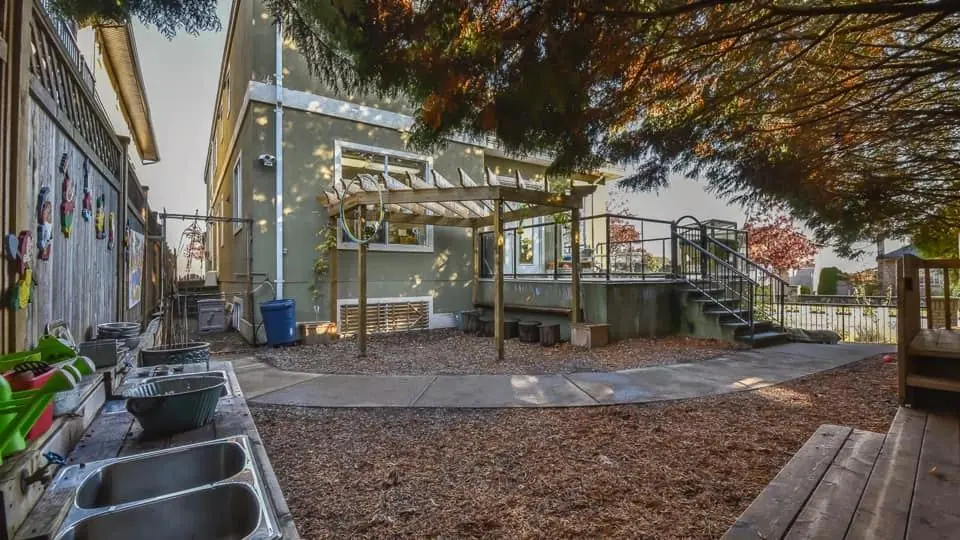
Most of the Child Care Licensing Regulation is about people. A smaller part is about the building, and that part is unusually easy for a parent to use, because it is written in numbers you can see with your own eyes.
You will not be measuring anything on a tour. But knowing that the floor is 3.7 square metres per child changes what you notice, and it turns a vague feeling that a room is crowded into a question you can ask politely.
Indoor space
A licensee must provide at least 3.7 square metres of usable floor area for each child.
The word usable is doing work. The measurement excludes hallways, built-in storage areas, bathrooms, and fixed appliances or large appliances that are not normally moved from one area to another. So a room's total footprint is not the number that counts.
Family Child Care and Child-minding are exempt from this requirement, and Recreational Care has its own looser rule requiring only that the usable floor area in activity areas is sufficient for the health and safety of the children taking part.
The arithmetic is worth carrying with you. Sixteen children need at least 59.2 square metres of usable space. Twenty-five need 92.5.
Toilets and wash basins
One toilet and one wash basin for every ten children or fewer.
Except in Family Child Care and In-Home Multi-Age Child Care, those facilities must be on the same floor as the community care facility. That rule exists because a toddler who has to be walked up a flight of stairs is a toddler whose group is briefly short an adult.
Recreational Care instead requires sufficient urinals, toilets and wash basins to meet the needs of the children in care. School Age Care on School Grounds is exempt from most of section 14, but if care happens in a building without toilets, children's access to a bathroom must be supervised appropriately for their age and development.
Diaper changing
Every program except Preschool and Group Child Care (School Age) must have a sturdy diaper changing surface, located outside the food preparation area, next to both a covered container for soiled clothing and a wash basin.
A second rule reinforces it from the other direction: no surface used for food preparation, storage or consumption may be used for changing diapers.
Sleeping
Any program caring for a child younger than 36 months must provide a separate sleeping area located away from any activity area.
Each piece of sleeping furniture must be used by only one child at a time, be clean and comfortable, and be appropriate for the size, age and development of the children who use it.
Outdoor play area
At least 6 square metres of outdoor play area per child.
Where a centre holds more than one care program, the outdoor area must satisfy that requirement for the programme with the largest maximum group size permitted in Column 2 of Schedule E. So a centre running both a 25-child Group Child Care program and an 8-child Multi-Age group sizes its yard against the 25.
The whole outdoor area must be enclosed in a way suitable for the age and development of the children that keeps them free of harm, and built using materials suitable for those ages. The regulation does not prescribe a fence height or a surface type, which is why yards vary so much between centres that are all equally compliant.
Occasional Child Care and Child-minding are exempt from the outdoor area requirement. Family Child Care must provide an indoor and an outdoor play area, without the square metre figure attached.
Two groups may share one outdoor area at the same time only if they are the same type of care program under Schedule E, there is no increase in risk, the 6 square metres per child figure is still met, and each group's staffing ratio still holds.
Play materials and equipment
All indoor and outdoor play materials and equipment accessible to children must be suitable for their age and development, safely constructed, free from hazards and in good repair.
Furniture, equipment and supplies must be of sturdy and safe construction, easy to clean, free from hazards, and positioned so they do not block or hamper an exit in a fire or other emergency.
Section 17 adds a broad catch-all: children must not have access to any object or substance that may be hazardous to their health or safety.
Daily outdoor play
A licensee must provide each child with daily outdoor play periods unless weather conditions would make it unreasonable to do so.
That phrasing matters in this climate. Rain is not, by itself, a reason to stay in. Centres that go out in the wet tend to say so and to ask families for the right clothing, which is why rain suits and spare socks appear on so many what-to-bring lists in this region.
Occasional Child Care is exempt from providing outdoor activities. Child-minding is bound by the daily outdoor rule only when the program runs 3.5 hours or more per day.
Water temperature, smoking and cannabis
Heated water accessible to children must be no hotter than 49 degrees Celsius, in every program except School Age Care on School Grounds.
On the premises, or in a vehicle used to transport children, while children are under supervision: no smoking or use of tobacco, no holding lighted tobacco, no use or holding of an activated e-cigarette, no smoking or vaping cannabis. Cannabis may not be grown or stored on the premises at all, apart from medical cannabis, and a child who consumes medical cannabis must be supervised by an employee.
Accessibility
Where a child requiring extra support attends, the licensee must ensure the physical structure of the facility is modified to meet that child's needs while they attend. The child's care plan records what adaptations were made to the building and what modifications were made to the program of activities.
What the program itself has to include
The building rules pair with Schedule G, which sets program standards. A licensee must provide a coordinated program of indoor and outdoor activities covering five areas of development: physical, intellectual, language, emotional and social.
Some of the language requirement is specific enough to be useful. The program must include modelling of good language and listening skills, opportunities for children to develop receptive and expressive language, and activities that encourage communication. The emotional standard requires an atmosphere in which children can feel proud of their cultural heritage and cultural sharing is encouraged.
The measurable rules in one table
| Requirement | The rule | Who is exempt |
|---|---|---|
| Indoor usable floor area | 3.7 square metres per child | Family Child Care, Child-minding; Recreational Care has its own rule |
| Outdoor play area | 6 square metres per child | Occasional Child Care, Child-minding, Recreational Care |
| Toilets and wash basins | One of each per 10 children or fewer | Recreational Care has its own rule |
| Toilets on the same floor | Required | Family Child Care, In-Home Multi-Age Child Care |
| Separate sleeping area | Required where any child is under 36 months | Programs with no child under 36 months |
| Diaper change surface | Sturdy, outside the food preparation area, beside a covered bin and a wash basin | Preschool, Group Child Care (School Age) |
| Heated water reachable by children | No more than 49 degrees Celsius | School Age Care on School Grounds |
| Outdoor play | Daily, unless weather makes it unreasonable | Occasional Child Care; Child-minding under 3.5 hours a day |
| Fire drill practice | At least monthly, by every employee | None |
| Emergency plan practice | At least annually, by every employee | None |
What to look at on a tour
Stand in the room and count. How many children, how much clear floor. Look at where the sleeping area is relative to where the noise is. Look at the yard and ask what the group size is that shares it. Check whether the fence suits the ages you see. Ask what happens on wet days.
Then ask when the last licensing inspection was and whether anything in the physical facility category came up. Physical facility and equipment is one of the ten areas a licensing officer assesses, so the answer exists in writing and the centre will have a copy.
One more thing worth noticing, because it is not in the regulation at all. Air handling, air conditioning and the number of separate exits are not prescribed by the Child Care Licensing Regulation beyond the fire code requirements in section 22. A centre built specifically as a childcare facility often has more of each than one converted from a house or a retail unit, and neither arrangement breaches any rule. If those things matter to you, ask directly, because no inspection report will tell you.
Next, health, illness and medication covers what happens when a child gets sick.
Questions parents ask
Frequently asked questions
Licensed child care in BC