September 4, 2026
Toilet learning and daycare, and how the centre works with you
Why British Columbia's health guidance calls it toilet learning rather than training, the readiness signs worth watching for, and how a centre and a family keep one approach going across two buildings.
By Tracy, Owner and Principal
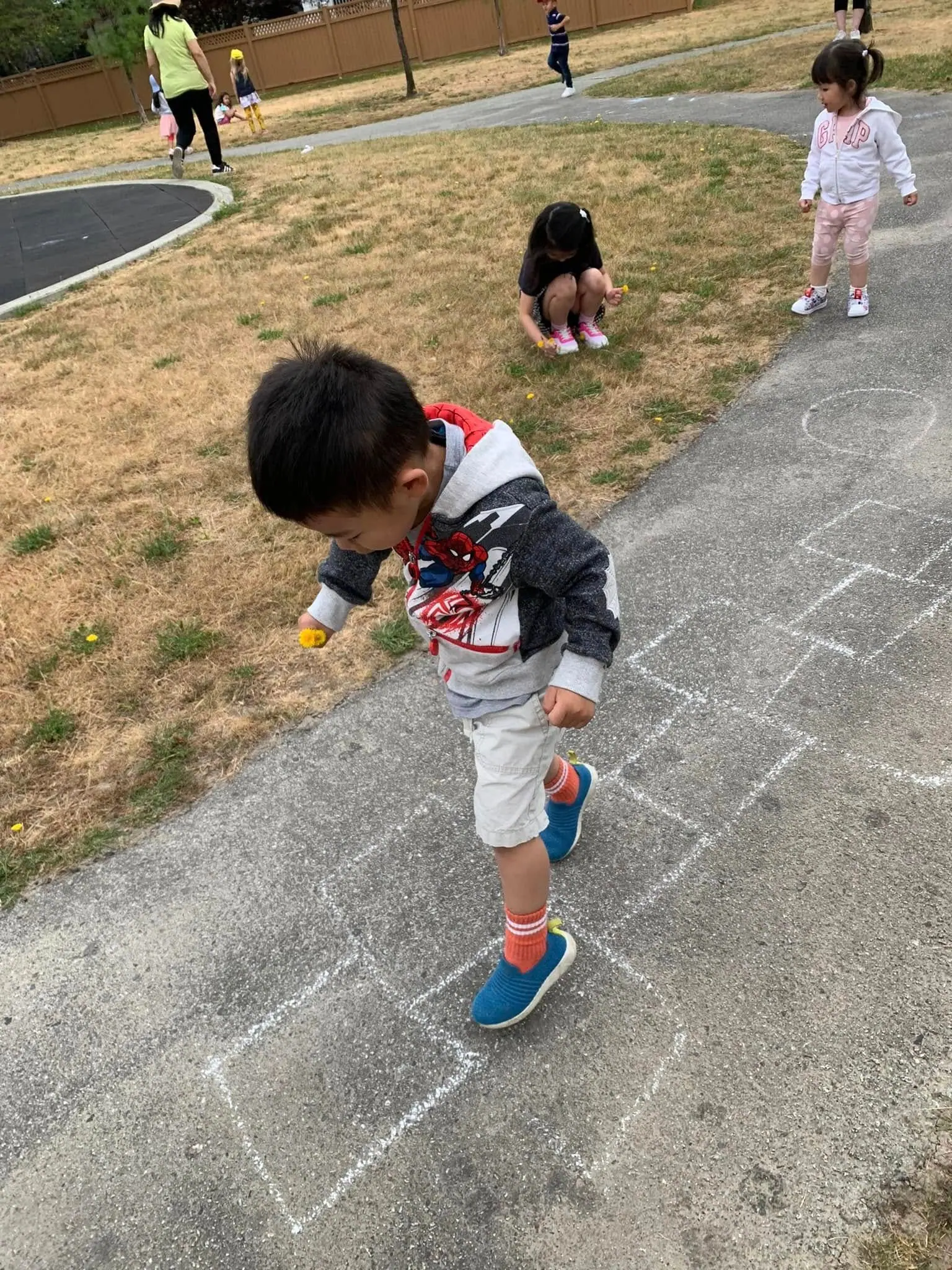
The question comes up on almost every tour, usually phrased as though there is a rule: at what age does my child have to be out of diapers.
There is no such age in British Columbia's rules for licensed child care. HealthLink BC is direct about it: there is no set age for starting to learn to use the toilet, or for becoming independent in toileting. What follows is how the process actually works, and how a centre and a family keep one approach running across two buildings.
Learning, not training
HealthLink BC uses the term toilet learning rather than toilet training, and the reason is not decoration.
Training implies an adult with a schedule. Learning describes what is actually happening, which is a child acquiring three separate skills: recognising that they are about to urinate or have a bowel movement, communicating that and asking for help if they need it, and holding the urge long enough to get to the potty.
Those are three different things and they arrive in their own order. A child can reliably tell you afterwards long before they can tell you beforehand. A child can hold on for thirty seconds long before they can hold on for two minutes. Progress that looks like stalling is usually one of the three skills catching up with the others.
HealthLink BC's guidance is also clear about pressure: rushing the process may make it more difficult and more frustrating for both of you. This is the single most useful line in the whole subject, and it is the one that is hardest to follow at 7:40 on a Tuesday morning.
The readiness signs
HealthLink BC suggests a child may be ready if you can answer yes to most of these:
Can your child walk to the toilet or potty?
Can your child sit by themselves on the toilet or potty?
Is your child staying dry for several hours?
Can your child follow a simple one or two step direction, like "let's go to the toilet"?
Can your child communicate that they need to use the toilet or potty?
Can your child pull down their pants without help?
Wanting to be more independent generally is another sign. And the minimum HealthLink BC sets out is that your child should be comfortable sitting on the toilet for a few minutes, positioned properly while seated.
On timing: most children show interest somewhere between 24 and 48 months, but not every child will show interest inside that range. That is a wide window on purpose. A child who is not interested at 30 months is inside the normal range, not behind it.
Why two places make it harder, and how to fix that
A child learning to use the toilet is reading the adults around them for what the rules are. When the rules differ between home and the centre, the child does the sensible thing and waits to find out which set applies.
That is the source of most toilet-learning trouble at a centre, and it is fixable with one conversation.
Tell us when you are starting, before you start. Not on day three when it is going badly. Ideally the week before, so the cubby is stocked and the educators in your child's room know to expect it.
Tell us the words you use. Pee, wee, potty, toilet, poo, number two: children respond to the word they know. An educator using a different word is adding a translation step to a moment that is already urgent.
Tell us what your child wears. Underwear, pull-ups, or diapers. We match what you do at home. A child in underwear at home and a pull-up here is being asked to learn two systems in the same week.
Tell us your approach. Some families take the child at set intervals. Some wait for the child to ask. Some do a mix. Any of these work. Two of them running at once do not.
Tell us what changed at home. A new baby, a house move, a grandparent visiting, a bad night. Educators reading a wet morning as a step backwards will respond differently from educators who know your child was up at three.
What the day looks like here
Toilet learning is folded into the existing routine rather than run as a separate programme. The natural points are on arrival, before and after outdoor time, before lunch, before and after nap, and before pick-up, plus whenever your child asks.
Educators go with your child, help with clothing where help is needed, and hand washing follows every time from the very first day. That last part is not a detail. It is the habit that outlasts the process by about seventy years.
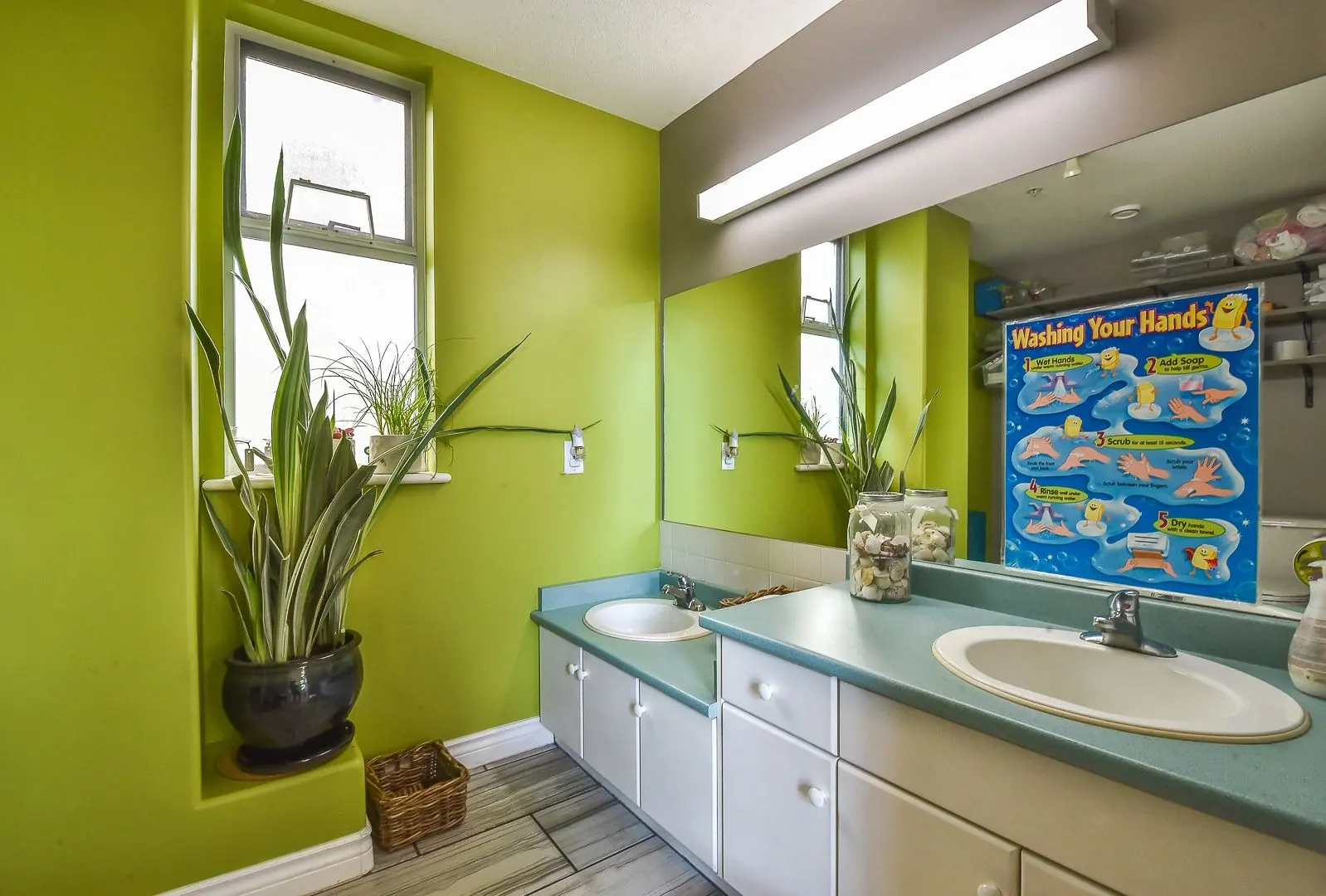
The washrooms here are built for children, with toilets and sinks at their height. That is a licensing requirement. A facility has to have toilets and hand basins suited to the ages of the children using it, along with proper diapering arrangements where they are needed. It is one of the things a licensing officer looks at, and it is worth noticing on any tour: a child who needs an adult to lift them onto an adult toilet is not going to be independent in it.
Accidents
There will be accidents. Plural, and for longer than you expect.
Here is what happens when one occurs. An educator changes your child calmly and without comment. The wet clothes go into a bag to come home. A fresh set comes out of the cubby. Then everyone goes back to what they were doing.
No consequence, no discussion in front of the other children, no note home framing it as a problem. The reason is practical rather than sentimental: a child who becomes anxious about accidents starts holding on, and a child who holds on gets constipated, and constipation is the single most reliable way to turn a three-week process into a three-month one.
If your child does start withholding or seems in pain, that is a conversation with your health care provider rather than something to manage with a new routine at either end.
The cubby, restocked
Three or more complete sets of clothes, and more in the first weeks. Complete means shirt, pants, underwear and socks, because an accident rarely limits itself to one garment.
Plus enough diapers or pull-ups for the day, if you are using them.
The rhythm that works: a set goes home in a bag, and the replacement comes in the next morning. Families who restock weekly instead usually get a phone call on a Thursday. A centre that has run out of your child's clothes has no option but to ring you.
Everything labelled, as with the rest of the bag. The full list is in what to pack for daycare.
One more thing worth getting right: dress your child in clothes they can manage alone. Elastic waists, no buttons at the front, no belts, no dungarees. A child who can pull their own trousers down gets to the toilet in time. A child who needs an adult to undo something does not, and the delay is often the whole difference.
Regression
Almost every child goes backwards at some point, and it almost always follows a change. A new sibling. A move. An illness. A new room at the centre. A holiday.
Treat it as information rather than as a failure. Go back to the previous step, drop the pressure, and let it come back. It usually does, faster than the first time.
What does not help is a reward chart introduced at the moment of regression, because it adds a performance element to something the child has just told you they cannot currently do.
Tell us what changed, and we will match whatever you decide to do at home.
What we write down
Section 57 of the Child Care Licensing Regulation requires a centre to keep a current record for each child, including any special instruction about the child's diet, medication, participation in activities, or other matter relevant to their care, where the parent gives it in writing and the centre agrees to it.
For most families toilet learning is a conversation rather than a formal instruction. Where there is something specific, a medical condition, a particular routine your provider has recommended, or a plan you want followed exactly, it belongs in writing so it survives a staffing change. The same logic applies here as it does to allergies.
What to ask a centre on a tour
Since centres set their own policies here, this is worth asking directly rather than assuming.
Do you enrol children who are still in diapers, and does that change by room?
Who changes a child, and where?
What happens when a child has an accident?
How do you match what we do at home?
How many spare clothes do you want us to keep here?
The answers tell you something beyond toileting. A centre that has thought carefully about this has usually thought carefully about the rest, and the tone of the answer, whether accidents sound like a normal Tuesday or a complication, tells you how your child will be treated on their worst day. There are more questions like these in questions to ask on a daycare tour.
Frequently asked questions
What age should a child be out of diapers for daycare?
There is no such age at a licensed centre in British Columbia, and a centre that sets one is applying its own policy rather than a rule. HealthLink BC states there is no set age for learning to use the toilet, and most children show interest somewhere between 24 and 48 months.
Why is it called toilet learning instead of toilet training?
Because the child is the one doing the learning. HealthLink BC uses the term to signal that the process follows the child's cues rather than an adult's timeline, and that every child arrives at it differently.
How do I know my child is ready to start?
HealthLink BC suggests your child may be ready if most of these are true: they can walk to the toilet, sit on it by themselves, stay dry for several hours, follow a simple one or two step direction, tell you they need to go, and pull their own pants down. Wanting to be more independent is another sign.
Should we start at home first or at daycare first?
Start wherever the calmer week is, then tell the other place immediately so both are doing the same thing. What causes most of the trouble is not the order, it is two adults running two different approaches in the same week.
What happens when my child has an accident at the centre?
An educator changes them calmly, without comment or consequence, puts the wet clothes in a bag to go home, and takes a fresh set from the cubby. Accidents are part of learning rather than a setback, and treating them as a problem is what turns a short process into a long one.
How many spare clothes does my child need during toilet learning?
Three or more complete sets, meaning shirt, pants, underwear and socks, and more in the first weeks. Restock the cubby whenever a set goes home, because a centre that runs out is a centre calling you to collect your child early.
Can a centre refuse to enrol a child who is still in diapers?
That is a decision each centre makes about its own operation rather than something the provincial rules require. Ask directly on the tour, because the answer tells you whether the centre expects to work with your child's development or around it.
What if my child regresses after doing well for weeks?
Regression is normal and it usually follows a change: a new sibling, a house move, an illness, a new room. Go back to the earlier step without making it a subject, and tell us what changed at home so we are not reading the same behaviour as something else.
Should we use pull-ups at daycare?
Tell us what you use at home and we will match it. What matters most is that the same thing happens in both places, because a child who wears underwear at home and a pull-up here is being asked to learn two different sets of rules at once.
Coming to see us
We are at 1103 Confederation Drive in the Citadel neighbourhood of Port Coquitlam. If you want to see the washrooms and how the routine fits around the rest of the day, our daily schedule sets out the shape of it, and you are welcome to arrange a visit.
Copies a ready-written post, then opens LinkedIn.