October 10, 2026
How a two-year-old's vocabulary actually grows, and what adults can do
Word learning in the third year depends on back-and-forth conversation rather than on how many words a child hears. What a conversational turn is, why narrating your day works, and when to raise a concern.
By Tracy, Owner and Principal
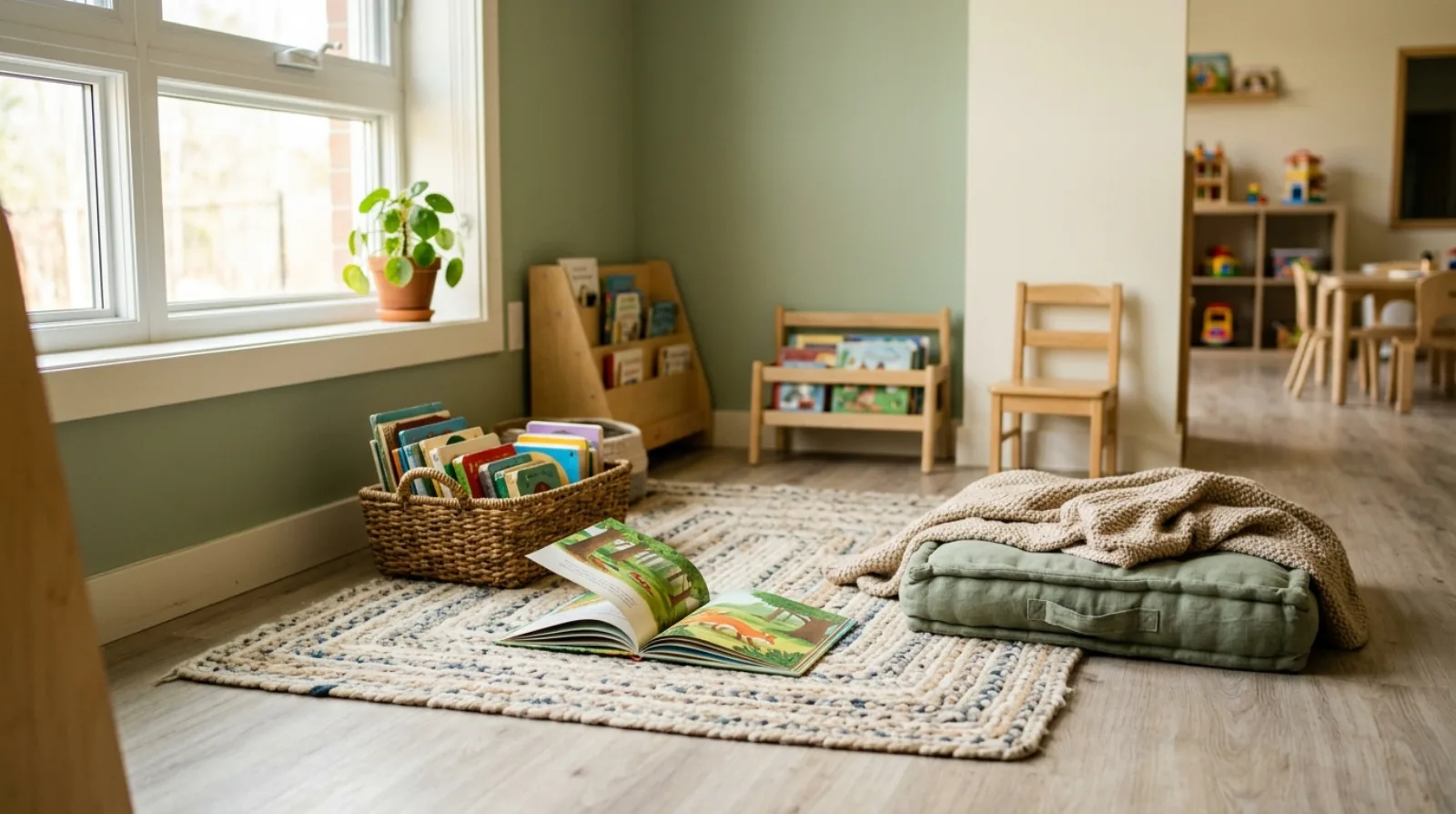
The advice a parent gets about a toddler's language is almost always the same three words: talk to them.
It is not wrong. It is just the least useful form of a more precise finding, and the precise version changes what you would actually do on a Tuesday afternoon.
Turns, not volume
The thing that carries most of the weight in early language development is not how many words wash over a child. It is how many back-and-forth exchanges they take part in.
A turn looks like this. The child does something or says something. An adult responds to that specific thing. The child responds to the response.
That loop is the unit. A parent talking steadily in the car while a child looks out the window is producing a large number of words and approximately zero turns. A parent who says four sentences across ten minutes, each one answering something the child did, has produced far less speech and considerably more of what matters.
Once you see language this way, several bits of common advice reorganise themselves.
The first change: wait longer
This is the highest-value adjustment available to most parents, and it costs nothing.
A two-year-old hearing a question has to work out what was said, decide what they think, retrieve the words, and assemble them in order. That takes time. Considerably more time than an adult needs.
Adults tend to wait about a second before filling a silence. Which means we routinely end the exchange at precisely the moment the child was getting ready to take their turn.
Count silently to five before speaking again. It feels ridiculous, it looks like nothing is happening, and it is where a startling number of turns come from. Try it once this evening and watch how often a child answers at four.
The second change: follow their attention
A word is learned most easily when it arrives attached to the thing a child is already looking at.
If your child is staring at a digger, this is a moment to say something about the digger. Not about lunch, not about what you were going to point out, not about the letter D. The digger.
This sounds obvious and adults break it constantly, because we arrive with our own agenda for the conversation. A toddler who points at something has told you exactly where their attention is. Talking about that thing means the word and the meaning land together.
Related: use the precise word. A two-year-old can learn excavator as readily as truck, and heron as readily as bird. The specific word is no harder and it is more useful.
The third change: add one step
When your child says something, reply with roughly one increment more than they produced.
Child says "dog". You say "a big dog". Child says "big dog run". You say "the big dog is running fast".
Just ahead, not far ahead. A reply pitched several steps beyond what a child can currently manage passes over them. One step is a model they can reach for.
The same move handles mistakes. A child who says "him goed there" does not need correcting, they need to hear the right version inside a natural reply: "yes, he went there". This is called recasting, and it works better than correction for a practical reason. Correction teaches children that speaking invites criticism, and children who feel that say less. Saying less is the outcome you least want.
The fourth change: repeat things
A word does not move from heard to used in one encounter. It takes many.
Which is why reading the same book for the fortieth time is not a failure of variety, it is the mechanism working. Each reading is another exposure, and children start noticing different things: a detail in a picture, a word they skipped, a rhythm in a sentence.
The most useful reading habit is not finishing the book. It is stopping wherever your child's attention stops, and talking about that page for as long as they want. A book finished in order with a bored child does less than three pages with an interested one.
Our post on reading aloud and Tri-Cities library programs covers the free storytime programmes local libraries run, which are worth using.
The words adults use least
Two categories are worth deliberate attention because they are systematically underused.
Spatial words. Over, under, beside, between, behind, through, edge, corner, top, bottom, taller, wider. Ordinary talk with children is dominated by objects and actions, and position words get skipped. They are also connected to spatial reasoning, which our post on block play and early maths goes into.
Feeling words. Frustrated, disappointed, nervous, excited, jealous, proud. A child who can say "I am frustrated" has an alternative to demonstrating frustration on the floor. Naming the feeling as it happens, in the moment, is how these get learned. Our post on why toddlers cannot share on demand covers the related self-regulation side.
What about screens
Less than parents hope, and the reason is structural rather than moralistic.
Young children learn language from people who respond to them. A recording cannot respond. It proceeds identically regardless of what the child does, which breaks the turn-taking loop that does the work.
The Canadian Paediatric Society does not recommend screen use for children under two, other than video chatting with caring adults such as extended family, and suggests limiting routine screen use for children two to five to about an hour or less a day.
The video chat exception is the proof of the principle. A grandparent on a call is a real person, waiting, responding, laughing at the right moment. The turns still happen. Our post on screen time and young children works through the rest of this.
If your child is bilingual
The counting works differently and this causes unnecessary worry.
A bilingual child's vocabulary is spread across two languages. Count only one and the number looks low, while the total across both is generally comparable to a monolingual child's. A child who knows "dog" in English and "chien" in French knows a concept and two words for it.
Caring for Kids New to Canada, the Canadian Paediatric Society's resource, is direct on the family side of this. It states that parents should not feel pressured to speak a second language for fear that they are risking their child's language development, success in school or integration into Canadian society, and that when parents use their first language they are offering the best language models to their child, modelling a rich, diverse vocabulary and appropriate grammatical structures.
It goes further, advising that parents should never be told to limit a bilingual child's exposure to only one language, even when a language disorder is diagnosed.
Mixing words from two languages in one sentence is also normal. The same source describes the child using words from both languages in the same sentence to help replace words they do not know. It is a sign of resourcefulness rather than confusion. Our guide to raising a bilingual child covers this in full.
When to raise a concern
Word counts from the internet are a poor instrument, and the temptation to measure a child against a number is strong. Better questions:
Is the vocabulary growing over time, whatever its current size? Does understanding appear to be ahead of speaking, which is usually reassuring? Is your child using language to interact with people rather than only to label things? Are words being combined by around age two?
A child who is not gaining new words, who does not combine words, who does not use language socially, or whose understanding also seems limited is worth discussing with a health care provider. So is your own persistent sense that something is different, which is worth taking seriously rather than talking yourself out of.
Getting it looked at early costs little. Waiting to see costs more if something is there.
How this works at the centre
Vocabulary here grows out of conversation attached to what children are actually doing rather than out of exercises. Educators narrate during play, ask about what a child is building, and respond to what a child brings them.
The three language programmes, French, Mandarin and English, run separately so educators can give focused, age-appropriate instruction in the selected language. That structure matters for turns: a child in a programme hears sustained, connected talk in one language from an adult who is responding to them, rather than a mixture that never settles.
Educators give families verbal updates at pick-up about how a child is communicating, among other things, and a family can ask for a private meeting at any point for a longer conversation. Our post on what learning two languages actually does for a toddler covers what the multilingual side contributes.
The British Columbia Early Learning Framework names communication and literacies as one of its four living inquiries, with pathways including multiple modes of communication, vocabulary, symbols and written language, and sound and word play. That is a description of language growing through use in ordinary situations rather than through instruction.
The short version
Talk less. Wait longer. Talk about whatever your child is looking at rather than what you had in mind. Reply with one step more than they gave you. Read the same book again.
None of it requires a programme, a product or an extra half hour in a day that does not have one.
Frequently asked questions
How many words should a two-year-old have?
There is wide normal variation, and a single count is a poor measure on its own. What speech-language professionals generally look at alongside vocabulary size is whether a child is combining words, whether their understanding is ahead of their speaking, whether they use language to interact rather than only to label, and whether their vocabulary is growing over time. If you are concerned about your child's language, speak to a health care provider or ask about a speech-language assessment rather than relying on a word count from the internet.
What is a conversational turn?
An exchange where a child does or says something, an adult responds to that specific thing, and the child responds again. The back-and-forth is what makes it a turn. An adult talking steadily at a child who is not engaged produces words without turns, and it is the turns that carry most of the value for language learning.
How long should I wait for my child to respond?
Longer than feels natural, and much longer than most adults wait. A two-year-old needs time to understand what was said, decide on a reply and find the words for it. Adults tend to fill a silence after about a second, which ends the exchange at exactly the moment the child was preparing to take a turn. Counting silently to five before speaking again is a useful discipline.
Should I correct my child's mistakes?
Recast rather than correct. If a child says "him goed", replying "yes, he went to the park" gives them the correct form inside a natural response without turning the exchange into a lesson. Direct correction tends to make children say less, and saying less is the outcome you least want. Children work grammar out from hearing correct forms in context over time.
Does reading the same book over and over help?
Yes, and it is one of the more efficient things you can do. Repetition is how a word moves from recognised to used. A child hearing the same book for the fortieth time is not stuck, they are consolidating, and each reading is a chance to notice something new. Following their attention within the book matters more than finishing the pages in order.
My child understands everything but says very little. Is that a problem?
Understanding running ahead of speaking is common and by itself is usually reassuring, since comprehension generally develops first. What is worth raising with a health care provider is a child who is not gaining new words over time, who does not combine words by around age two, who is not using language to interact with people, or whose understanding also seems limited. Trust your own sense that something is different.
Does being bilingual delay vocabulary?
A bilingual child's words are distributed across two languages, so a count in one language alone looks smaller while the total across both is generally comparable to a monolingual child's. Caring for Kids New to Canada is explicit that parents should not feel pressured to speak a second language out of fear for their child's development, and advises never recommending that parents limit a bilingual child's exposure to one language, even when a language disorder is diagnosed.
Do educational apps and videos build vocabulary?
Far less than people expect. Young children learn language from people who respond to them, and a recording cannot respond. The Canadian Paediatric Society does not recommend screen use for children under two apart from video chatting with caring adults, and suggests limiting routine screen use for ages two to five to about an hour or less a day. Video chat is treated differently precisely because a real person is taking turns.
What kinds of words should I be using?
Whatever the actual situation contains, rather than a list. Words for space and position are worth attention because adults use them least: over, under, between, edge, corner, behind, through. Feeling words are worth naming as they come up, since a child who can say frustrated has an alternative to demonstrating it. Precise words beat simplified ones, and a two-year-old can learn excavator as easily as truck.
How does the centre support vocabulary?
Through conversation attached to what children are actually doing, rather than through drills. Educators narrate, ask and respond during play, meals and routines. Because French, Mandarin and English run as separate language programmes, a child hears sustained, focused talk in the selected language throughout the day rather than a mixture. Educators also give families verbal updates at pick-up about how their child is communicating.
Before you visit
If you want to hear how educators talk with children here, a tour is the way to judge it. Tours run about thirty minutes by appointment and you are welcome to bring your child. Contact us to arrange one, or read about our language programs.
Copies a ready-written post, then opens LinkedIn.